Pháp Nhãn Temple Ven. Thích Pháp Nhãn Ven. Thích Trừng Sỹ
INTRODUCTION TO PHÁP NHÃN TEMPLE AND ITS WEBSITE
Namo the Original Teacher, Shakyamuni Buddhaya
With deepest respect, we address the Venerable Monks and Nuns,
Dear Dharma friends and readers near and far,
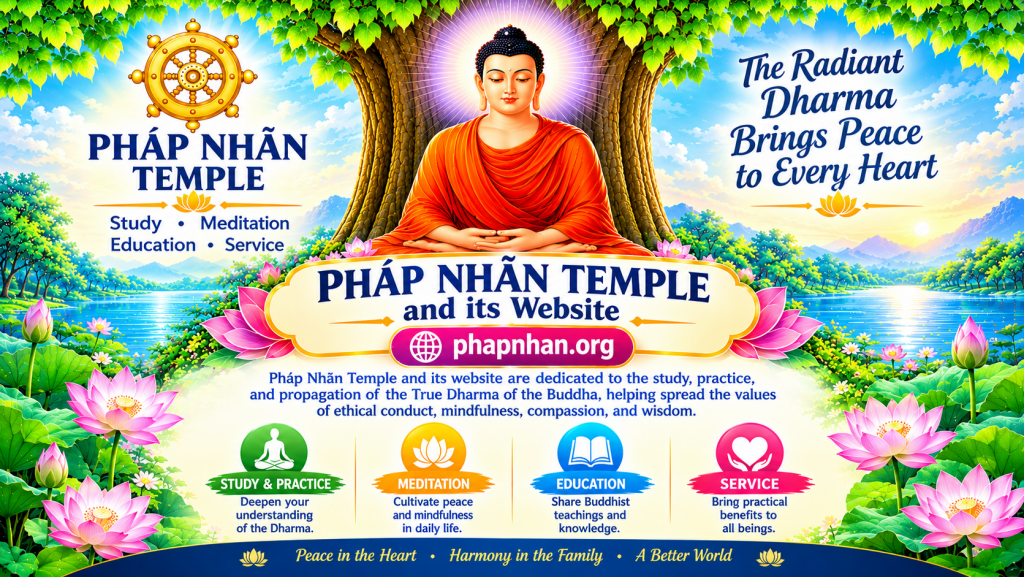
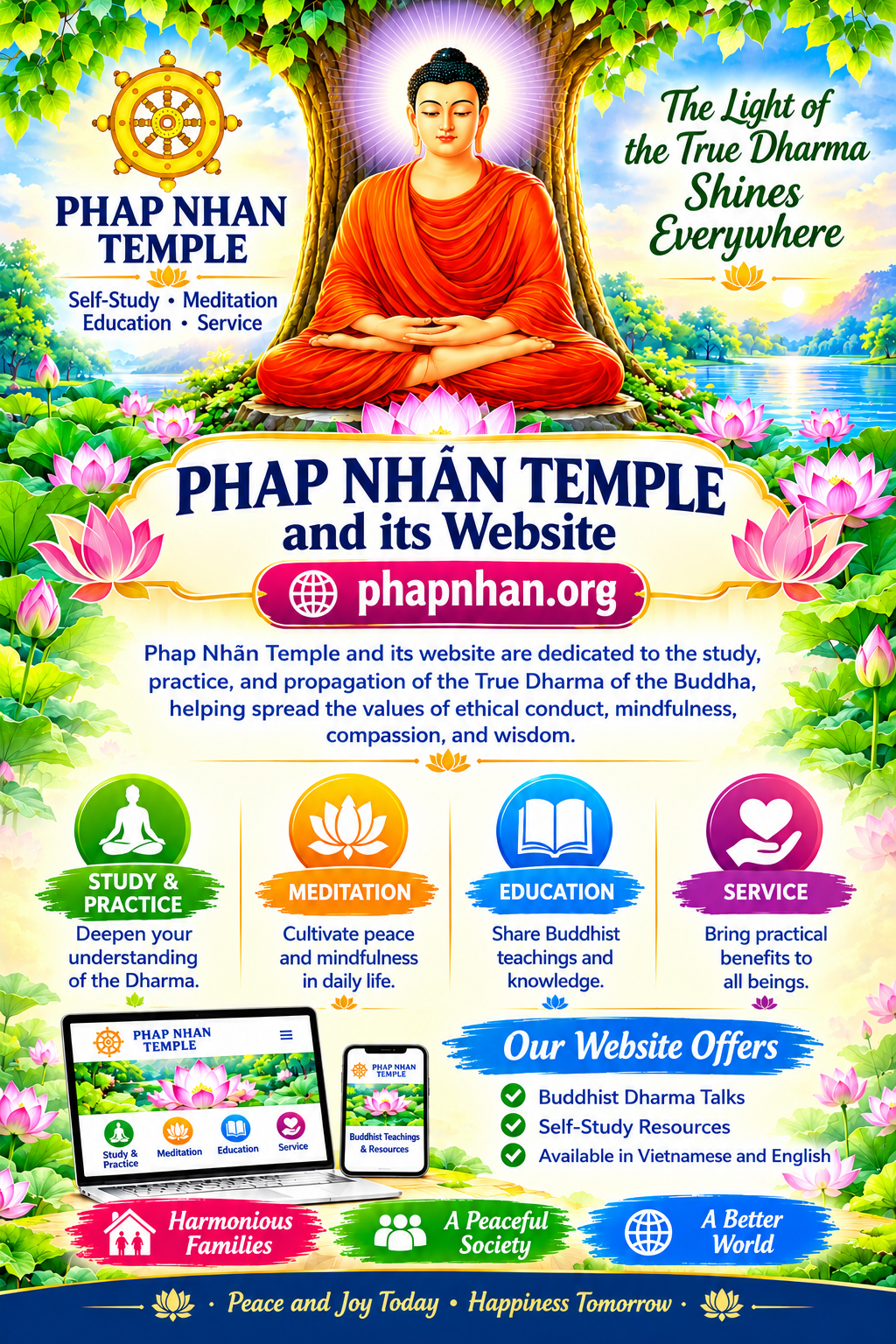
Pháp Nhãn Temple and its website (phapnhan.org) are dedicated to the study, practice, and propagation of the True Dharma of the Buddha, helping spread the values of ethical conduct, mindfulness, compassion, and wisdom. The temple serves as a place for Buddhist study, meditation, education, and service, while the website shares Buddhist teachings and knowledge, Dharma talks, and study materials in both Vietnamese and English. Through these efforts, Pháp Nhãn Temple and its website aspire to bring peace, happiness, and practical benefits to all, contributing to harmonious families, a peaceful society, and a better world.
I. Aspiration to Propagate the True Dharma
Buddhism, the path of peace, awakening, and enlightenment, has been present in the world for more than twenty-six centuries. Shakyamuni Buddha, the fully awakened Teacher, opened the path leading to peace, awakening, and liberation. Following his noble aspiration and example, generations of the Buddha’s disciples, from ancient times to the present, have continually devoted themselves to learning, practicing, and propagating the True Dharma, thereby contributing to the well-being and benefit of humanity and all sentient beings.
Following the altruistic example and noble aspiration of the Buddha and generations of his disciples, we aspire to live a life of virtue and mindfulness, steadfast and at ease; to keep the torch of the True Dharma shining brightly and to kindle the torch of loving-kindness and compassion; and to walk the path of peace and joy, aspiring to cultivate true happiness for ourselves and others right here and right now, in this very life.
With the aspiration to continue, preserve, and further promote the noble values that the Venerable Masters have diligently cultivated over the years, the Editorial Board has had the good fortune to establish the Pháp Nhãn Temple Website in today’s era of global communication and connectivity. The website serves as an effective communication platform that helps propagate the True Dharma, spread loving-kindness, cultivate wisdom, and bring peace, joy, and happiness to people around the world.
II. The Origin and Meaning of the Name Pháp Nhãn
The name Pháp Nhãn is closely associated with the Pāḷi term Dhammcakkhu, commonly translated into English as the Eye of the Dhamma, meaning “the eye of the Dharma.” This term holds an important place in Buddhist scriptures and is particularly associated with the account of Shakyamuni Buddha’s first discourse, the Dhammacakkappavattana Sutta (Discourse on Turning the Wheel of the Dhamma), recorded in the Saṃyutta Nikāya (Connected Discourses), Chapter 56, Discourse 11 (SN 56.11; S V 420–424).
The Buddha delivered this discourse to five ascetics at the Deer Park (Isipatana Migadāya), near the city of Bārāṇasī (modern-day Varanasi), India. While listening to and understanding the True Dharma, Venerable Aññā Koṇḍañña attained the Eye of the Dhamma, realizing the truth expressed in the words: “Whatever arises is subject to cessation.” Following this event, Venerable Aññā Koṇḍañña was accepted by the Buddha into the monastic order, becoming his first ordained disciple. The other four ascetics were also successively guided and ordained by the Buddha, marking the formation of the first Buddhist monastic community in the history of Buddhism.
Following this important historical event, the Triple Gem—the Buddha, the Dhamma, and the Sangha—can be likened to a three-legged vessel, with its three legs interdependent and mutually supportive, providing a stable foundation in the world. The Triple Gem serves as a noble spiritual refuge for the Buddha’s disciples, who rely upon it to study, practice, and apply the Buddha Dharma in their daily lives, cultivating peace and progressing toward awakening and liberation.
From a Sino-Vietnamese perspective, the name Pháp Nhãn consists of two elements: Pháp and Nhãn. Pháp, corresponding to Dhamma in Pāḷi, refers to the Buddha’s teachings and the truth they convey. Nhãn, corresponding to cakkhu, means “eye.” Thus, Pháp Nhãn can be interpreted as “the Eye of the Dhamma,” symbolizing right seeing and the ability to understand the Buddha’s teachings through wisdom.
In the Pāḷi scriptures, the Eye of the Dhamma (Dhammacakkhu) is often associated with the realization of truth and the recognition of the arising and passing away of phenomena. In this sense, the Eye of the Dhamma points toward a path of learning and practice guided by the Noble Eightfold Path, which consists of Right View, Right Intention, Right Speech, Right Action, Right Livelihood, Right Effort, Right Mindfulness, and Right Concentration.
The Eye of the Dhamma is also closely connected with understanding the Four Noble Truths: the Noble Truth of Suffering, the Noble Truth of the Origin of Suffering, the Noble Truth of the Cessation of Suffering, and the Noble Truth of the Path Leading to the Cessation of Suffering. Together, these truths offer a clear understanding of suffering, its origin, its cessation, and the path to its cessation. Through studying, contemplating, and practicing the Buddha’s teachings, Buddhist practitioners can gradually develop wisdom, transform suffering, and cultivate a life of peace, happiness, and inner freedom, while also benefiting others.
III. The Eye of the Dhamma in the Five Eyes of Mahāyāna Buddhism
In the Five Eyes of Mahāyāna Buddhism, the five types of eyes are the Physical Eye, the Divine Eye, the Wisdom Eye, the Eye of the Dhamma, and the Buddha Eye. They represent different aspects and levels of perception and understanding, ranging from ordinary sensory perception to the complete wisdom of enlightenment.
1. Physical Eye (肉眼)
The Physical Eye represents the ordinary human eye, which enables people to see forms and recognize objects and phenomena within the normal range of sensory perception.
2. Heavenly Eye (天眼)
The Heavenly Eye represents the ability to see beyond the ordinary limits of the physical eye, including the ability to perceive different realms of existence and the death and rebirth of sentient beings according to their karma.
In terms of perception beyond the limits of the naked eye, the Divine Eye may be broadly compared to scientific instruments such as telescopes and modern observation devices, which enable human beings to observe distant objects and phenomena that cannot be seen directly with the naked eye.
However, these two abilities differ in their fundamental nature. Scientific instruments extend the capacity for observation through technology, whereas the Divine Eye, according to Buddhist teachings, is a faculty of mental perception associated with perceiving different realms of existence, as well as the death and rebirth of sentient beings according to their karma. Therefore, the Divine Eye should not be equated with the ability to observe through scientific instruments.
3. Wisdom Eye (慧眼)
The Wisdom Eye represents the ability to contemplate and understand the true nature of phenomena, recognizing their impermanence, suffering, non-self, dependent arising, and conditioned nature. Through such contemplation, practitioners can develop wisdom, lessen attachment, transform suffering, and move toward liberation. From a practical perspective, understanding the interdependent relationships among things and phenomena also helps people live more responsibly, appreciate the value of life, and cultivate compassion for all living beings.
4. Dharma Eye (法眼)
The Dharma Eye represents the ability to understand the Dharma, recognize the truth, and discern the path of practice. From a practical perspective, the Dharma Eye also refers to the ability to make sound judgments, distinguish between what should and should not be done, and understand appropriate methods of practice to guide oneself and help others attain well-being, peace, and happiness.
5. Buddha Eye (佛眼)
The Buddha Eye represents the Buddha’s perfect vision and understanding, fully penetrating the truth and comprehending the true nature of phenomena. According to Mahāyāna Buddhism, the Buddha Eye also represents the ability to recognize the spiritual capacities, circumstances, and conditions of sentient beings in order to guide them appropriately, helping them transform suffering, develop wisdom, and progress toward awakening and liberation.
In summary, within the Mahāyāna Buddhist system of the Five Eyes, the Physical Eye enables one to perceive objects through ordinary vision; the Heavenly Eye represents the ability to see beyond the normal limits of sight; the Wisdom Eye represents the ability to contemplate the true nature of phenomena through wisdom; the Dharma Eye represents an understanding of the True Dharma and the path of practice; and the Buddha Eye represents the Buddha’s perfect vision and understanding.
These five types of eyes belong to the Mahāyāna Buddhist classification system. When studying the term Dharma Eye in the Pāli Canon and in the Mahāyāna Buddhist system of the Five Eyes, it is important to consider the context in which the term is used and its specific meaning within each tradition.
IV. The Buddha Eye, the Dharma Eye, and the Sangha Eye: Interbeing and Practical Application
In addition to the Five Eyes, in relation to the Triple Gem—the Buddha, the Dharma, and the Sangha—we may use the terms Buddha Eye, Dharma Eye, and Sangha Eye as symbolic concepts to highlight the connections among enlightened wisdom, understanding of the True Dharma, and the Sangha’s shared vision of harmony, reconciliation, and unity. This interpretation is intended to support the practical application of Buddhist values in everyday life; it is not intended to establish a canonical system of terminology equivalent to the Five Eyes.
The Buddha Eye (Buddhacakkhu) may be understood symbolically as the vision of the Enlightened One, representing profound wisdom, clear insight, and a profound understanding of compassion, wisdom, peace, and equality. The Buddha Eye reminds Buddhist practitioners to follow the noble example of the Blessed One, cultivate wisdom alongside compassion, and live mindfully in all circumstances.
The Dharma Eye (Dhammacakkhu) emphasizes right understanding of the True Dharma and the ability to study, understand, contemplate, practice, and apply the Buddha’s teachings in everyday life. The Dharma Eye guides people toward right understanding, ethical conduct, the cultivation of wisdom, and the gradual transformation of the underlying causes of suffering.
The Sangha Eye (Saṅghacakkhu) may be understood symbolically as the collective vision of the Sangha, nurtured by moral integrity, wisdom, purity, harmony, unity, and a shared sense of responsibility. In a community where members listen to, respect, support, and encourage one another, each member can contribute an individual perspective, enabling the community to assess issues more comprehensively and identify appropriate solutions together. The Sangha Eye thus embodies the spirit of mutual support, mutual care, loving-kindness, mutual respect, reconciliation, and collective progress.
Although the Buddha Eye, the Dharma Eye, and the Sangha Eye are presented separately, they are closely interconnected and mutually supportive. The Buddha Eye reminds us of the ideal of enlightenment and wisdom; the Dharma Eye emphasizes the right understanding, study, and practice of the True Dharma; and the Sangha Eye highlights harmony, mutual support, and the collective pursuit of Buddhist study and practice. These three aspects can serve as complementary guides on the path of Buddhist learning, practice, and service.
From the perspective of interbeing, we recognize that all things and phenomena exist through relationships of interdependence, mutual conditioning, and interaction. Therefore, individual development cannot be separated from family, community, and the surrounding environment. When wisdom goes hand in hand with compassion, understanding is accompanied by practice, and individual aspirations are harmonized with shared responsibilities, people can contribute to building a more peaceful, compassionate, and wholesome way of life.
Through the study, understanding, and practice of the Buddha Dharma, we can apply the symbolic meanings of the Buddha Eye, the Dharma Eye, and the Sangha Eye to everyday life to cultivate wholesome qualities, strengthen right confidence, develop wisdom, live with stability and ease, and bring meaningful benefits to ourselves and others.
V. The Significance and Vision of Pháp Nhãn Temple
Pháp Nhãn (Dhammacakkhu in Pāḷi; the Dharma Eye in English) is the name of both this temple and this website. The temple is a place for venerating the Buddha, studying and practicing the True Dharma, providing moral education, and organizing Buddhist activities. In the Buddhist tradition, the term vihāra generally refers to a residence and place of practice, particularly for monastics. Depending on the context, it may correspond to terms such as monastery or monastic residence.
With this vision, Pháp Nhãn Temple aspires to foster an environment for studying and practicing the True Dharma, cultivating moral values, and developing wisdom. In doing so, the temple seeks to nurture individuals who are knowledgeable, ethical, and responsible. Through its activities in Dharma study and practice, meditation, education, and service, the temple hopes to contribute to building harmonious families, a peaceful society, and a better world.
Those who have the good fortune to encounter the temple and come to learn about, study, and practice the Buddha Dharma can gradually learn to recognize and transform the difficulties they face in life, cultivate mindfulness, compassion, and wisdom, and find greater peace, joy, and happiness for themselves while contributing to the well-being of others right here and now, in this very life.
Choosing the name Pháp Nhãn for the temple reflects the continuity of this term’s significance within Buddhist teachings while conveying the temple’s vision of studying and practicing the True Dharma and cultivating wisdom.
Through these activities, people can gradually cultivate peace and joy, develop wisdom, strengthen their moral values, transform the difficulties they face in daily life, and build positive relationships with family, friends, and society. These are among the practical goals that Pháp Nhãn Temple aspires to achieve through its ongoing activities in Dharma study and practice and the propagation of the True Dharma.
VI. Location, Establishment, and Activities of Pháp Nhãn Temple
Pháp Nhãn Temple is situated on approximately 2.55 acres of land at 136 The Ranch Road, Del Valle, Texas 78617, about 8.5 miles from Austin-Bergstrom International Airport.
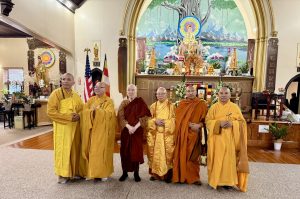
Following the exemplary tradition of supporting the Triple Gem embodied by the lay disciples Anāthapiṇḍika and Visākhā, devoted Buddhist supporters generously purchased and donated this land to enable Venerable Thích Trừng Sỹ to establish Pháp Nhãn Temple. The temple was established with the aspiration of becoming a place where people can learn about, study, apply, and practice the Buddha Dharma in their daily lives, serving Buddhists and non-Buddhists alike, both near and far.
At present, Pháp Nhãn Temple regularly conducts activities in Dharma study and practice and the propagation of the True Dharma. However, its physical facilities and material resources remain modest and limited. Despite these limitations, under the dedicated guidance of Venerable Thích Trừng Sỹ, Buddhists and others who have the good fortune to encounter the temple have opportunities to learn about, understand, practice, and apply the Buddha Dharma in their daily lives.
Through these activities, people can gradually cultivate peace and joy, develop wisdom, cultivate moral virtues, transform the difficulties they face in daily life, and build positive relationships with family, friends, and society. These are among the practical goals that Pháp Nhãn Temple aspires to achieve through its ongoing activities in Dharma study and practice and the propagation of the True Dharma.
VII. Introducing the Pháp Nhãn Temple Website and Its Content Vision
Through the topics presented above, the Pháp Nhãn Temple website respectfully introduces readers to Pháp Nhãn Temple, Venerable Thích Trừng Sỹ, his writings, and works by other authors that align with the website’s principles, purposes, and vision for development.
The content published on the Pháp Nhãn Temple website focuses on Buddhist study and practice, education, Dharma propagation, the protection and preservation of the Buddha Dharma, and its application to daily life. Articles that fall outside these areas or do not align with the website’s stated vision and direction are beyond the scope of its publications.
To make it easier for a wide range of readers to learn about and practice the Buddha Dharma, the Pháp Nhãn website (phapnhan.org) offers content in both Vietnamese and English. Through this bilingual platform, readers can access articles, Dharma talks, and study materials to gradually deepen their understanding of the Buddha’s teachings, put those teachings into practice, and apply the values of ethical conduct, mindfulness, compassion, and wisdom to their daily lives.
In today’s era of global communication and connectivity, a website is a valuable means of sharing Buddhist knowledge, promoting humanistic values, and supporting Buddhist study and practice remotely. Wherever they may be, readers can learn about the Buddha’s teachings, reflect on his words, and choose practices suited to their own circumstances.
With the aspiration to propagate the True Dharma, Pháp Nhãn Temple and its website seek to contribute to this noble mission by bringing peace, happiness, and practical benefits to ourselves and others throughout the world.
VIII. Words of Gratitude and Best Wishes
In the process of compiling, editing, publishing, organizing, and presenting articles, the Editorial Board may inevitably make mistakes or overlook certain details. We respectfully welcome the guidance and suggestions of Venerable monks and nuns, scholars, knowledgeable individuals, intellectuals, and Dharma practitioners, so that the website’s content may continue to improve in quality, accuracy, and usefulness for readers near and far.
Finally, the Editorial Board would like to express its deepest gratitude to the Venerable monastics, kind-hearted benefactors, generous donors, devoted Buddhist practitioners, and all those who have contributed to, supported, and accompanied Pháp Nhãn Temple in sustaining its activities of Dharma study, practice, and the propagation of the True Dharma.
Their invaluable generosity and support help enable the Temple to continue fulfilling its aspirations in Dharma study and practice, education, service, and encouraging people to apply the Buddha Dharma in their daily lives.
May the blessings of the Triple Gem bring peace and well-being in body and mind to all Venerable monastics, virtuous friends and wise companions, Buddhist practitioners, and readers near and far. May their families live in harmony, their work proceed smoothly, their wisdom continue to grow, and their lives become ever more peaceful, joyful, and happy.
We respectfully wish you continued diligence in Dharma study and practice, and steady progress on the path of learning, understanding, practicing, and propagating the True Dharma of the Blessed One. May your efforts help foster a life of peace, mindfulness, compassion, and wisdom for yourselves and others, right here and now, in this very life.
Namo the Original Teacher, Shakyamuni Buddha.
Editorial Board of the Pháp Nhãn Temple Website
phapnhan.org
Related articles