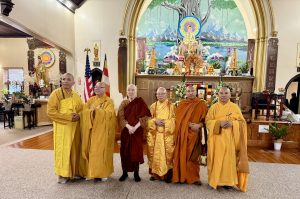
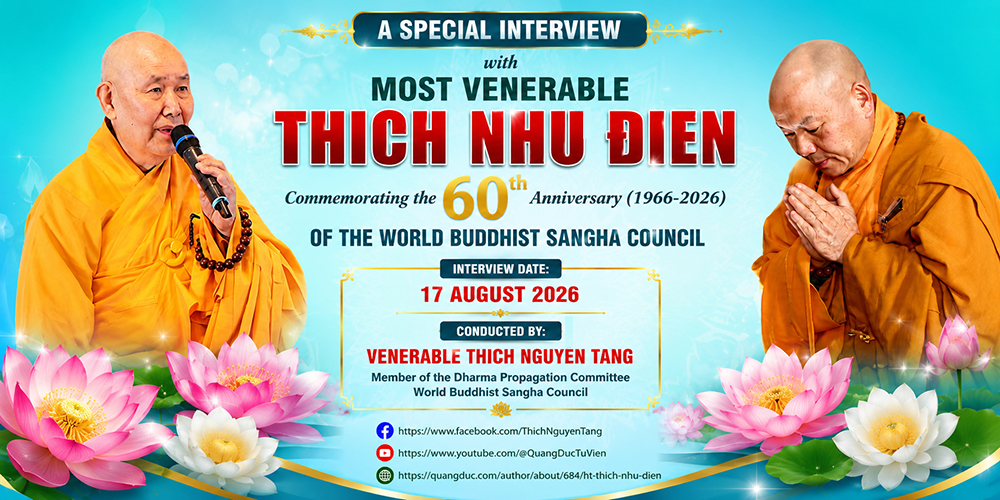
HT. Thích Như Điển TT. Thích Nguyên Tạng
A Special Interview with Most Venerable Thich Nhu Dien Commemorating the 60th Anniversary (1966–2026) of the World Buddhist Sangha Council
Interview Date: 17 August 2026
Conducted by:
Venerable Thich Nguyen Tang
Member of the Dharma Propagation Committee
Introduction:
For over six decades of monastic life, Buddhist study and practice, and service to the Triple Gem, Most Venerable Thích Như Điển has undertaken a remarkable journey marked by perseverance, wisdom, and a deep aspiration to propagate the Dharma. From his native Quảng Nam, he traveled to Japan for further study and later to Germany, where he gradually established Viên Giác Pagoda as an important center of Vietnamese Buddhism and culture in Europe. He has always regarded learning and practice as two mutually supportive aspects of the path toward awakening and liberation. Through decades of Dharma propagation, education, translation, and literary work, he has continually sought to connect the Buddha Dharma with the needs of people and the realities of the times. He emphasizes that while methods of Dharma propagation may change according to circumstances, the True Dharma, together with compassion, wisdom, and the commitment to benefit sentient beings, must be preserved. His has been a quiet yet steadfast journey of service, leaving lasting contributions to Vietnamese Buddhism overseas and to the global Sangha.
For more than six decades in the robe of the Tathagata, Most Venerable Elder Thich Nhu Dien has devoted his entire life to Buddhist practice and study, education, Dharma propagation, the translation of Buddhist scriptures, and the establishment of a firm foundation for Vietnamese Buddhism overseas. Born in his native province of Quang Nam, he entered monastic life at Phuoc Lam Ancestral Temple in Hoi An in 1964. Through favorable causes and conditions, he later went to Japan for higher education, and in 1977 arrived in Germany, where together with the Vietnamese Buddhist community he gradually established Vien Giac Temple in Hannover. In time, the temple became one of the prominent centers of Vietnamese Buddhist and cultural life in Europe.
In addition to his close involvement in the establishment and development of the Unified Buddhist Church of Vietnam in Europe, the Most Venerable has devoted great energy to Dharma propagation, education, and the translation of Buddhist scriptures. With a rich body of writings and translations in several languages, he currently bears the responsibility of Chairman of the Central Translation Committee. For many years, he has also participated in international Buddhist activities and has been invited to serve as Vice President of the World Buddhist Sangha Council (WBSC).
As we approach the 60th anniversary (1966-2026) of the World Buddhist Sangha Council, the Hoang Phap & Quang Duc Websites respectfully present this special interview with Most Venerable Thich Nhu Dien. Through this conversation, we hope to look back with him upon the important stages of a lifetime of Buddhist study, practice, and service: from his homeland of Vietnam to Japan, Germany, and Europe; from the early days of the Vien Giac Buddhist Practice Center to the present-day Vien Giac Temple; and from Dharma propagation, the training of Sangha members, and the translation of scriptures to Buddhist activities connecting members of the Sangha throughout the world.
Our wish is not merely to hear the Most Venerable recount the events of one lifetime. More importantly, we hope to listen to the causes and conditions behind those events, the hardships encountered while propagating the Dharma in foreign lands, the lessons distilled from more than six decades of monastic life, and his reflections and aspirations concerning the future of Vietnamese Buddhism and the worldwide Sangha.
On behalf of the readers of the Hoang Phap, Vien Giac & Quang Duc Websites, we respectfully express our profound gratitude to the Most Venerable for graciously taking the time to participate in this special conversation, and we respectfully invite our readers to follow the interview.
I. ENTERING MONASTIC LIFE, BUDDHIST STUDY, AND THE FIRST STEPS ON THE PATH
1/ Senior Venerable Thich Nguyen Tang: Most respectfully, Venerable Sir, in 1964, while still very young, you entered monastic life at Phuoc Lam Ancestral Temple in Hoi An. What causes and conditions led a young son of Quang Nam to make the decision to become a monk, and what images from those first days in the temple remain most deeply engraved in your memory?
Most Venerable Elder Thich Nhu Dien: First of all, I would like to thank Senior Venerable Thich Nguyen Tang very much for his thoughtful and meaningful intention to interview senior Buddhist masters who are still with us today. And now, I too have been included among those whom you wish to interview. I shall therefore answer your questions with the utmost sincerity, for the readers of the Quang Duc, Hoang Phap, and Vien Giac Websites.
I was born in 1949 in My Hac Village, Xuyen My Commune, Duy Xuyen District, Quang Nam Province, into a middle-class farming family. My father was Mr. Le Quyen, Dharma name Thi Te. He took refuge under Most Venerable Thich Nhu Van, Abbot of Phuoc Lam Ancestral Temple in Hoi An. My father was born in 1898, toward the end of the nineteenth century, and passed away on the ninth day of the seventh lunar month in 1986, at the venerable age of eighty-nine.
I was born in 1949, toward the end of the first half of the twentieth century, and was the youngest child in a family of five sons and three daughters. My mother was Ho Thi Kheo, Dharma name Thi Sac. She was born in 1908 and lost her life because of the war on March 27, 1966. By that time, I had already been a monk for two years.
In my village there was a temple called Ha Linh. It was the place where the Ha Linh Buddhist Youth Association gathered for its activities. This very Buddhist Youth Association later became the cradle from which many people entered monastic life and eventually became senior monks and nuns, such as Most Venerable Thich Bao Lac, Most Venerable Bhikkhuni Thich Nu Dieu Tam, Most Venerable Bhikkhuni Thich Nu Dieu Chi, Most Venerable Bhikkhuni Thich Nu Nhu Vien, Most Venerable Bhikkhuni Thich Nu Dieu Phuoc, Most Venerable Bhikkhuni Thich Nu Dieu Nghia, and others.
I began participating in the Ha Linh Buddhist Youth Association in 1958, when I was nearly ten years old. Songs such as Young Men of the Grey-Robed Buddhist Youth, One Day, One Day, on the First Day of the Month We Go to the Temple, Sister Dam and the Children, We Are Birds, and others were part of those early years. Under the full moon in the countryside, those childhood songs imbued with the spirit of Buddhism gradually penetrated deeply into my heart.
In 1963, following the Buddhist struggle movement, my Master, the late Most Venerable Thich Long Tri, Abbot of Vien Giac Temple in Hoi An, was invited by the temple’s lay management committee to give Dharma talks. Toward the end of 1963, I took refuge under him and received the Dharma name Nhu Dien. I have continued to use that Dharma name until this very day.
Later, when I received the novice ordination in 1967 at Pho Da Temple in Da Nang, my Master gave me the Dharma courtesy name Giai Minh. Then, in October 1971, when I received full Bhikkhu ordination at Quang Duc Monastery in Thu Duc, where the late Most Venerable Thich Quang Lien served as the head of the monastery, my Root Master bestowed upon me the Dharma title Tri Tam.
At that ordination ceremony, Most Venerable Thich Tri Thu served as the Presiding Preceptor, Most Venerable Thien Hoa as the Karmacarya, and Most Venerable Hanh Tru as the Teaching Acarya. At that same ordination, Venerable Minh Phat of An Quang Temple received novice ordination.
Most Venerable Thich Bao Lac, my elder brother, had also participated in the Ha Linh Buddhist Youth Association. In 1957, on the eighth day of the second lunar month, he left home to enter monastic life. His departure left our family with indescribable longing and sadness, especially after reading the letters he had left behind.
At that time, however, I myself had no thought that I would one day become a monk. Gradually, through repeated visits to Non Nuoc Temple in Da Nang, where the late Most Venerable Thich Tri Huu was Abbot, I began to sense what I would call the fragrance of the meditative life, and around 1960 the aspiration to enter monastic life began to arise within me.
Yet I did not dare tell my parents, because I had not yet completed primary school. It was not until the summer of 1961, after finishing primary school, that I made up my mind to ask my parents for permission to become a monk. But they kept postponing the matter and would say:
“You are the youngest child in the family. Besides, your elder brother has already become a monk. Why must another son leave home as well?”
I remained silent and waited for the right opportunity.
At the beginning of 1964, I asked them once again, this time with a very firm determination:
“If Father and Mother do not allow me to go, I will run away from home just as Seventh Brother did” – that is, Most Venerable Thich Bao Lac.
After several weeks of discussion between them, my father said to me:
“If your mother agrees, then I will allow you to go.”
When I went to ask my mother, she said:
“If your father agrees, then I will allow you to go.”
At that moment, I felt that the way had finally opened before me.
I began preparing everything I thought a young novice monk would need, even though I had not yet gone down to Hoi An to inform my Root Master of my intention.
The day I chose to leave home was the full-moon day of the fifth lunar month in 1964. That day was also the death anniversary of my paternal grandfather, so all of my brothers and sisters had gathered at my parents’ home. Two of my brothers-in-law and one sister-in-law were also there, while the nieces and nephews were still very young.
After the memorial ceremony for my grandfather was completed, I went upstairs, bowed before the Buddha, and said farewell to my family. I left home in the intense heat of summer. Everyone in the house was crying, their eyes following me as I departed, while I myself smiled because I felt that I had finally conquered my own hesitation.
I got on my bicycle and rode directly to Vien Giac Temple in Hoi An to present myself to my Master.
My Master was not surprised. He simply said: “I must go to Saigon for medical treatment. Take this letter to Phuoc Lam Ancestral Temple, meet Venerable Nhu Van, the Abbot, present the letter to him, and explain to him what you wish to do. When I return from Saigon, I will have someone call you back to Vien Giac so that your head may be shaved and you may formally enter monastic life.”
Afterward, my Master gave me a loose-fitting traditional tunic with very wide panels. I treasured that robe and kept it until I moved to Saigon in 1969.
On the nineteenth day of the sixth lunar month in the Year of the Dragon, 1964, I was summoned back to Vien Giac Temple. My Master, the late Most Venerable Thich Long Tri, formally shaved my head and admitted me into monastic life.
That very same day, I rode my bicycle back to Phuoc Lam Ancestral Temple to continue my Buddhist training together with the monastic community. At that time there were Venerable Hanh Thu, Venerable Hanh Duc, Venerable Hanh Chon, and others.
Thus, all the necessary causes and conditions had finally come together, enabling me to enter monastic life at these two ancestral temples in Hoi An, Quang Nam, in the year 1964.
2/ Senior Venerable Thich Nguyen Tang: Your Root Master was the late Most Venerable Thich Long Tri, one of the renowned “Four Pillars of Quang Nam.” Throughout your life of Buddhist practice and study, what were the most important qualities or teachings that you inherited from your Root Master?
Most Venerable Elder Thich Nhu Dien: My Master was born into a distinguished and respected family in Minh Huong Village, Hoi An. His father at one time served as the village chief of Hoi An township; his elder brother was Congressman Ly Truong Tran, a member of the opposition bloc in the Lower House during the Second Republic under President Nguyen Van Thieu. Because of this background, my Master was naturally very intelligent, quick-minded, decisive, and resolute in whatever he did. He would not defer to people simply because they held authority or high office, even within the Buddhist establishment itself. For that reason, there were also quite a number of people who did not like him.
The “Four Pillars of Quang Nam” at that time were: the late Most Venerable Thich Chon Phat, Abbot of Long Tuyen Ancestral Temple; the late Most Venerable Thich Nhu Van, Abbot of Phuoc Lam Ancestral Temple; the late Most Venerable Thich Nhu Hue, Abbot of the Quang Nam Provincial Buddhist Association Temple, which was later renamed Phap Bao Temple; and my Master, who was Abbot of Vien Giac Ancestral Temple.
In the summer of 1966, I asked permission from Most Venerable Thich Nhu Van to return to Vien Giac Temple for further practice. At that time, still young and sensitive, I had been deeply affected by several unpleasant incidents that had taken place in the temple, and therefore I asked to leave Phuoc Lam Ancestral Temple.
Returning to Vien Giac, however, did not mean that I would live in peace. That year, Most Venerable Thich Tri Quang issued the call for the “Buddha altars to be brought into the streets.” At temples throughout Central Vietnam, many monks were arrested and imprisoned. My Master and I also endured imprisonment for three months. My Master was detained in Saigon, while I was confined at the Quang Nam National Police headquarters.
On March 27, 1966, for the first time in my life, I cried throughout the entire day when I learned that my mother and my aunt had been caught in an attack by agricultural aircraft of the national forces in a contested area where fighting was taking place with troops of the National Liberation Front of South Vietnam.
And yet, from that day until now, when I am nearly eighty years old and have spent more than sixty-two years in the temple and engaged in Buddhist work in many places, I have never again cried. Perhaps I will not cry again until the lid of my coffin is finally closed. Nor have I ever laughed in self-satisfaction, even in private, when I successfully completed some project. This is because I understand that crying and laughing are merely relative opposites within this life.
I have also never taken much pride in myself. I often think that even the grasses and wild plants growing along the roadside can still blossom, displaying beautiful colors and offering fragrance to the world. So what is there for me to be proud of?
Moreover, my mother was illiterate, while my father was very well versed in classical Chinese. My mother did not teach us brothers and sisters any lofty doctrines, but she herself was a shining example that we were to follow throughout our lives. Her teaching was simply this: toward those older than ourselves, we must show respect; toward those younger than ourselves, we must know how to yield and be considerate.
With only those few teachings, I carried them with me throughout my entire life and applied them in daily living. As a result, things generally passed in favorable ways, and hardly any adversity ever caused me to lose courage. This came from the strong will of my Master and from the example of sacrifice, endurance, and patience shown by my simple country mother.
I learned many outstanding qualities from my Root Master. He also never praised me in front of other people, even though he knew that I was one of the most exemplary and outstanding students at Bo De High School in Hoi An during the academic years 1965-1966, 1966-1967, and 1967-1968. Before that, during the academic year 1964-1965, I studied in the Seventh Form at Dien Hong Private High School together with Most Venerable Thich Giai Trong, Most Venerable Thich Nhu Pham, and others.
At the end of the Fourth Form school year in 1968, I received three awards. The first was for ranking first in my class; the second was for being the best student in the entire school among 900 students; and the third was for excellent conduct, diligence, and never missing a single day of school. At that time, the late Most Venerable Thich Nhu Hue was the Academic Director of Bo De High School in Hoi An.
Because of those three awards, I was allowed to transfer to Tran Quy Cap Public High School to study in the Third Form. Five of us were transferred into the A, B, and C sections. They were: Most Venerable Thich Nhu Pham, who is now the Abbot of Long Tuyen Ancestral Temple in Hoi An; Duong Hua Nguyen, now a medical doctor living in Saigon; Phung Ran, who later died during the war; Nguyen Thi Thu Huong, now a pharmacist; and myself.
After completing Third Form A at Tran Quy Cap High School, when Mr. Tong Khuyen was the principal, I left Vien Giac Temple in Hoi An and went to Saigon. I stayed at Hung Long Temple on Minh Mang Street in Cho Lon so that I could continue my studies in the Second Form at Cong Hoa High School under Professor Pham Van Van during the academic year 1969-1970.
During the academic year 1970-1971, after completing the full Baccalaureate, I prepared to leave for further study in Japan. There were many reasons for this, but in essence I simply wanted to search for and discover new things in another part of the world.
During the years when I lived at Vien Giac and Phuoc Lam, every summer the Venerable Masters allowed me to go to Long Tuyen Ancestral Temple, where Most Venerable Thich Chon Phat was the Abbot, to study the Sutras, Vinaya, and Abhidharma for three months. Thanks to this training, classical Chinese and Buddhist teachings gradually began to penetrate my understanding, alongside the secular education I was receiving in school.
3/ Senior Venerable Thich Nguyen Tang:
You pursued both Buddhist studies and secular education, and you were an outstanding student before going to Japan for further study. In your experience, for a monastic practitioner, how should Precepts, Concentration, Wisdom, Buddhist studies, and secular education support and complement one another?
Most Venerable Elder Thich Nhu Dien: This is indeed a very important matter for monastics such as ourselves. For that reason, in one of my collections of Dharma sayings, I once wrote: “Learning alone cannot bring us to enlightenment and liberation. Yet if we wish to open the door to liberation, neither cultivation nor learning can be dispensed with.” As I grew older, I spent a great deal of time reading books, Buddhist scriptures, and journals. In truth, when I was young, I was quite lazy when it came to studying and reading. At the end of my primary school education in 1961, before I entered monastic life, I was ranked near the bottom of my class.
From that experience, I came to realize that success never comes by itself. Every achievement requires determination, effort, and perseverance. Results do not arise spontaneously; they are the fruits of diligent work.
The French have a saying: “Aide-toi, le ciel t’aidera” (“Help yourself, and Heaven will help you.”) The meaning is that one must first rely upon one’s own efforts before expecting assistance from others. In Vietnamese, there is a similar proverb: “Có công mài sắt, có ngày nên kim.” (“If one persistently sharpens a piece of iron, one day it will become a needle.”) People often say that genius consists of only one percent talent and ninety-nine percent perspiration, determination, and hard work. In my own case, I belong to that ninety-nine percent.
As students of Buddhism, we learn the doctrine of Dependent Origination (Pratītyasamutpāda), which teaches: “When this exists, that exists;
When this arises, that arises; When this ceases, that ceases.” Everything arises through an intricate network of causes and conditions, an immeasurable interconnected process of dependent co-arising and continual transformation.
We are indeed fortunate to have been born as human beings and to have had the opportunity to become Buddhists. More fortunate still are those who have entered the monastic life and devoted themselves to the study and practice of the Dharma. From this perspective, the spiritual and the worldly are not separate realities. Rather, they interpenetrate and support one another, forming an inconceivable web of causes and conditions through which we may cultivate Precepts (Śīla), Concentration (Samādhi), and Wisdom (Prajñā). Therefore, secular education should not be regarded as contrary to Buddhist practice, nor should Buddhist learning be detached from the realities of daily life. When properly integrated, both become valuable supports on the path, enabling us to deepen our understanding, strengthen our cultivation, and advance toward wisdom and liberation.
4/ Senior Venerable Thich Nguyen Tang: In 1972, you went to Japan with a very modest scholarship, first studying the Japanese language, then majoring in Education at Teikyo University, and later pursuing graduate studies in Buddhism. How did those years in Japan influence your thinking, your approach to learning, and the direction of your Dharma propagation in later years?
On another occasion, I still carried with me a Vietnamese habit of thinking: if the temple already looked clean, why should it have to be cleaned twice every day? So I asked him about it, and he taught me: “If a practitioner cannot clean the temple properly, how can he ever clean his own mind?”
After hearing this, I bowed my head and quietly walked back toward the reception room to continue cleaning.
These were only ordinary incidents. There were many other stories involving receiving guests, chanting sutras, giving Dharma talks, traveling, and so forth – dozens of stories that could still be told.
But in the end, I would simply like to say this: I bow my head in gratitude to all those whom I have mentioned above, as well as to the many unnamed people who also helped me – friends and fellow countrymen such as Phan Duc Loi, Nguyen Thong, and many others.
5/ Senior Venerable Thich Nguyen Tang: Looking back on your journey from a young novice in Hoi An, to a Vietnamese monk studying in Japan, and later propagating the Dharma in Germany, what would you consider to be the most important turning point that changed the direction of your life?
Most Venerable Elder Thich Nhu Dien: Indeed! Today, as I sit and look back after more than sixty-two years of living in temples and nearly eighty years in this world, I sometimes feel that the person who accomplished all those things could hardly have been myself. Whatever I have been able to accomplish seems to have been arranged beforehand by the Three Jewels, rather than deliberately planned by me.
It is true that I myself conceived the idea of entering monastic life. Yet when I became a young novice at Phuoc Lam Ancestral Temple and Vien Giac Ancestral Temple in Hoi An, Quang Nam, at the age of fifteen, I never imagined that I would have to pursue higher education or obtain one academic degree after another. Nor did I ever understand why I was able to retain things in my memory for so long and speak so many languages, while my parents and my brothers and sisters did not have those abilities.
I was born into this world and, by all expectations, should have been holding a plough and a hoe, working as a farmer. Instead, somehow I ended up holding a calligraphy brush and a writing pen. Whenever I plant trees, they rarely bear fruit; yet when I cultivate people, they blossom. These things, I believe, arise from causes and conditions and from the results of many previous lifetimes; they are not something that I myself created.
Long ago, when I entered monastic life, some elderly women in my village said to one another: “Mr. Quyen’s family has two sons who have gone abroad.”
They actually meant to say that two sons had entered monastic life. But then, in 1972, I truly did go abroad, crossing the sea to study in Japan. In 1974, Most Venerable Thich Bao Lac also went to Japan, continuing his own path of diligent study and scholarly cultivation.
In April 1977, when I went to Germany on a tourist visa, I thought I would stay for only three months and then return to Japan to complete my graduate program in Buddhist Studies at Rissho University in Tokyo. But that did not happen. I left Japan and remained away for nearly fifty years, and my postgraduate studies in Tokyo were never fully completed.
Then, upon arriving in Germany, an entirely new horizon opened before me.
I had never imagined that I would build a temple, guide disciples in both the monastic and lay communities, or travel to visit and propagate the Dharma in eighty-five countries around the world. How could a simple person from the countryside ever have dared to imagine such things?
When I arrived in Germany, I encountered an entirely new environment. The German language was extremely difficult, much more difficult for me than English, French, or Japanese. And yet, somehow, I gradually integrated into German society without even realizing when that process had taken place.
I had obtained a driver’s license in 1974, when I returned from Japan to Vietnam for a one-month visit to my homeland. However, I drove only twice in Japan and then stopped. From that time until today, I have never again sat behind the steering wheel.
Because of this, many people have jokingly said that perhaps I was born simply to receive good news from the German Government and from Buddhist devotees everywhere, while rarely being disturbed by serious adversity.
That observation is not entirely wrong. Yet I myself do not really know why things have unfolded in this way.
Perhaps it is because, during forty annual Rains Retreats, each lasting three months from 1984 to 2024, I practiced bowing to the scriptures one character at a time, through such texts as The Five Hundred Names, The Three Thousand Buddhas’ Names, The Ten Thousand Buddhas Sutra, The Lotus Sutra, and The Mahaparinirvana Sutra.
By bowing to every single character, the teachings of the Buddha gradually entered and permeated my inner mind day after day, without my even being aware of it.
And perhaps it is also because I have practiced the Surangama Sutra continuously and diligently every morning, from the time I first entered monastic life until the present day.
Could these, perhaps, be the causes and conditions that have brought about the results of my life today?
6/ Senior Venerable Thich Nguyen Tang: According to your biography, you arrived in Germany on April 22, 1977. At that time, the Vietnamese community in Germany was still very small, and the conditions for propagating the Dharma must have been extremely difficult. What were your first days in Germany like?
Most Venerable Elder Thich Nhu Dien: I was a student who had only recently completed my studies in Japan when I came to Germany, bringing with me a modest amount of knowledge and without having prepared very much in advance. Yet causes and conditions arose one after another, and many opportunities came to me in rapid succession. In the book Huong Lua Chua Que (The Fragrance of Rice from the Village Temple), which Most Venerable Thich Bao Lac and I wrote together, most of the major events in the lives of the two of us have already been described in considerable detail.
I must say that I owe a great deal to Dr. Thi Minh Van Cong Tram. Tram had been my schoolmate during our primary school years in Xuyen My; she was also my benefactor and later became my disciple. Now both the Most Venerable Nun and Dr. Tram have passed away.
While I was studying German at the Volkshochschule in Kiel during the summer of 1977, Vietnamese students who had come to study abroad during the Republic of Vietnam period before 1975 would often invite one another to play football on weekends, or to go picking Kirschen – cherries when the fruit was ripe. Those were very happy times.
There were also times when I had almost no money left – or, more accurately, when I had to save whatever money I had in order to pay the monthly expenses for housing and food. At that time, Dr. Tram was still a medical student and lived in the same student residence on Holtenauer Street in Kiel.
On one occasion, Tram happened to see me riding my bicycle home after German class during the winter of 1977. It was bitterly cold. Instead of wearing gloves, I had wrapped my two hands in plastic bags so that I could ride my bicycle to and from school.
That memory later moved many people when Dr. Thi Minh Van Cong Tram wrote an article entitled: “Two Plastic Bags That Helped Build the Future of Vietnamese Buddhism in a Foreign Land.” Yet at that time, I never complained about hardship, nor did I ever complain that I lacked anything. Perhaps my determination was simply very strong then. I was not yet thirty years old, so I was still full of enthusiasm for the future, perhaps because the road ahead of me seemed so long.
If it were today, now that I am nearly eighty years old, I doubt that I would dare to think of doing such things again.
In February 1978, I moved to Hannover to continue postgraduate studies in Education. During the Vesak season in April 1978, I established the Vien Giac Buddhist Practice Center, under the spiritual witness and guidance of the late Most Venerable Thich Minh Tam.
At that time, there were very few Vietnamese living there. Only a small group of students gathered together, including Lam Dang Chau, Ngo Ngoc Diep, Nguyen Ngoc Tuan, Nguyen Thi Cuc, and others. During the daytime, I attended classes at the university. In the evening, I returned to chant sutras and practice Buddha-recitation. It was as simple as that.
Then, toward the end of December 1978, through the support and advocacy of Dr. Ernst Albrecht, who was then Minister-President of the State of Niedersachsen, the Federal Government of Germany accepted a number of Vietnamese refugees who had been drifting at sea and brought them to the Friedland Refugee Reception Center, near Gottingen. Dr. Ernst Albrecht was the father of Ursula von der Leyen, who is now President of the European Commission. Thus, I had the opportunity to work as an interpreter for the newly arrived refugees, translating from Vietnamese into German and from German back into Vietnamese, even though at that time I had been studying German for only a little more than one year.
This was similar to what had happened in Japan in 1975. At that time, a group led by Professor Le Kim Ngan, who had been Rector of the Phuong Dong University Institute at Vietnam National Temle (Vietnam Quoc Tu), arrived in Japan as refugees. I, together with a number of other Vietnamese students there, went to the refugee camp in Tokyo to serve as interpreters, translating from Japanese into Vietnamese and from Vietnamese into Japanese.
Most of the Vietnamese who arrived in Japan after 1975 hoped eventually to resettle in countries such as Australia, the United States, or Canada. Very few wished to remain permanently in Japan, because at that time the Japanese Government had not yet established a program to assist refugees in accordance with the proposals of the United Nations. And from these very causes and conditions, everything else gradually began to unfold.
7/ Senior Venerable Thich Nguyen Tang: Only one year later, in April 1978, you established the Vien Giac Buddhist Practice Center in Hannover. What led you to decide to establish a Vietnamese Buddhist place of practice in the midst of an unfamiliar Western country at that time?
Most Venerable Elder Thich Nhu Dien: Clearly, at that time I had no particular plan at all. I simply wanted to continue my studies and apply for asylum on religious grounds. But as I mentioned earlier, when Vietnamese refugees began arriving in the State of Niedersachsen, there arose a need for a Buddhist monk to perform the various traditional ceremonies associated with coming of age, marriage, funerals, and memorial rites. At that time, I was the only Vietnamese Buddhist monk there.
As for German Buddhist monks, I had not yet had an opportunity to establish contact with them, except through the German Buddhist Union (Deutsche Buddhistische Union), which also had a branch in Hannover at that time. I communicated with them using the German I had learned for just over a year, together with English, in order to explain the programs and activities I hoped to undertake.
Through television and newspaper reports, people came to know that I was a Vietnamese Buddhist monk helping as an interpreter at a hospital in Gottingen, not far from where Vien Giac Temple stands today. The Federal Ministry of the Interior of West Germany then took notice of my work and sent us an official invitation to travel to Bonn, which at that time was the provisional capital of West Germany during the period when Germany had been divided into East and West since 1949.
As a result, we received financial support from the German Government for twenty-five years, from 1979 until 2004. It was by no means a small amount of funding. The support was provided for cultural and religious activities organized by myself, together with the Vietnamese Buddhist Students and Overseas Community Association, as well as the German Chapter of the Unified Buddhist Church of Vietnam.
Because of these favorable causes and conditions, the foundations of Vien Giac Temple gradually began to take shape. From Kestnerstrasse, we moved to rented premises on Eichelkampstrasse. The German Government also provided financial assistance for the rent, electricity, gas, and water for a period of ten years.
Then, in 1991, when we officially moved into the newly constructed temple, the Government redirected its assistance toward supporting the printing of the books I had written, the publication of the Vien Giac magazine, and other activities.
Indeed, things simply seemed to come to us from somewhere, one after another. Even I myself had never expected such developments.
If, at that time, I had proposed to Dr. Geissler at the Federal Ministry of the Interior that the Government should build a Buddhist temple in Hannover for Vietnamese refugees who had fled communism, perhaps they would even have agreed to do so. But at that time, such an idea never occurred to me.
The reason was that, month after month and year after year, the German Government had already given the temple so much assistance.
Sometimes, perhaps, even the door of compassion should be closed before unnecessary demands, and the door of excessive expectation should also be gently shut. But in truth, at that time I never really thought about such things at all.
8/ Senior Venerable Thich Nguyen Tang: From a small Buddhist Practice Center established in 1978, Vien Giac Temple began construction in 1989 and was completed in 1993, eventually becoming an important Vietnamese Buddhist and cultural center in Europe. During that journey, which period was the most difficult, and which memory moved you the most deeply?
Most Venerable Elder Thich Nhu Dien: At that time, I had not yet intended to build a temple. However, Dentist To Vinh Hoa, Architect Tran Phong Luu, Dr. Nguyen Thi Hanh, and others kept encouraging me to undertake this project.
At the same time, we had very little money saved. Apart from the rather modest offerings made by Buddhist devotees who had recently arrived in Germany as refugees, the Vietnamese students who had come to study abroad before 1975 had only just begun their professional careers. They had plenty of willingness and energy to contribute, but their financial resources were still very limited.
Then one person offered one idea, and another person suggested something else. As a result, I could no longer simply sit still. I had to go out and search for land for the architect.
We wanted to purchase approximately 4,000 square meters of land, but at that time, how could we possibly have enough money?
Ms. Hanh suggested: “Venerable, perhaps you should divide the land into square meters and invite each Buddhist devotee to sponsor one square meter. Each family could contribute toward one or several square meters.” At that time, each square meter cost 135 Deutsche Marks (DM).
And so, after only about three or four months, we had raised enough money to purchase the 4,000-square-meter plot of land located directly across the road from the Beton Union company.
Architect Tran Phong Luu then began drawing the plans for the temple, while we started taking care of the necessary building permits.
Initially, we estimated that construction would cost approximately 3,000,000 DM. However, after four years of construction, from 1989 to 1993, the total cost had risen to 9,000,000 DM, equivalent to approximately 5,000,000 USD at that time.
Later, many people asked me: “Where did all that money come from? How did you ever think of such a fundraising program?”
I replied: “The money came from the bell and the wooden fish (chanting). If we strike the bell and wooden fish regularly, benevolent Dharma-protecting beings will call upon people of goodwill to bring their offerings to the temple. And I built this temple with the heart first; I did not begin with the money.”
It was precisely because the Buddhist devotees themselves had the sincere aspiration to build the temple that I began the project.
All of the fundraising methods that we used for the construction of the temple were methods I had learned from Most Venerable Thich Minh Tam: making offerings toward temple construction, establishing interest-free benevolent loan funds for the temple, sponsoring a brick for the temple, sponsoring a roof tile for the temple, and so forth.
Through all of these efforts, the work gradually came to successful completion.
There were happy moments and there were worrying moments as well, but I do not think I ever felt embarrassed about going out to raise funds.
For example, when we went into Japanese shops to ask for donations, we would bow so many times that our necks became tired. Yet when we finally presented the donation book, some people would write down a contribution of only 1 DM.
On another occasion, my disciples and I went into a Chinese restaurant to ask for a donation. The owner said: “I do not believe in Buddha, and I do not believe in God. I believe only in money.” We bowed politely and left.
It was amusing in its own way. I do not know whether that owner is still alive today. And if he has already passed away, what was he able to take with him? Perhaps, in the end, he too departed with nothing but two empty hands.
One day, we went to visit Thai restaurants to seek support. They received us very warmly and made offerings generously. It was not simply one person contributing; they would call all of their employees together and invite everyone to participate in making merit.
Not only that, they also gave us the addresses of other Thai people working nearby so that we could continue our fundraising efforts.
Somehow, without realizing it, we wandered into a red-light district, where women were selling their bodies in order to make a living.
I remained sitting in the car for quite a long time while Venerable Nun Hanh Ngoc and Venerable Nun Hanh Nhu went upstairs to ask for donations toward the construction of the temple.
At that moment, I thought to myself: what if a Vietnamese person happened to pass by and saw me sitting in a car in front of such a place? If that person took a photograph, he might then have an excuse to say:
“That Venerable Nhu Dien is not behaving properly.”
But he would have had no idea that I was actually sitting there waiting for the two Venerable Nuns to return.
To tell the truth, I was not expecting very much in terms of donations. What I felt more strongly was the discomfort of having to sit there waiting for more than an hour.
Eventually, the two Venerable Nuns returned to the car and handed me the donations that had been offered by those Thai women who were selling their bodies in order to survive.
On the pages recording their contributions toward the building of the temple, there were still traces of their lipstick…
I was deeply moved, and I remain profoundly grateful to everyone who contributed, including those Thai women on that particular day.
Today, it seems that the Hannover authorities have already closed down that district. And both of those Venerable Nuns have also returned to the Buddha several years ago.
I sometimes wonder: when they meet the Buddha and the Bodhisattvas and are asked about that experience, how will they tell this story?
9/ Senior Venerable Thich Nguyen Tang: Vien Giac Temple has not only served the Vietnamese community; many German people have also come there to study Buddhism, practice meditation, and explore Buddhist teachings. In your view, when introducing the Dharma into Western society, what should remain unchanged, and what should be adapted skillfully in order to suit the local culture?
Most Venerable Elder Thich Nhu Dien: Most Venerable Thich Nhat Hanh was very successful in introducing Buddhism to Westerners through the practice of Mindfulness Meditation and through the simple and accessible language he used when teaching Western audiences. My own approach is somewhat different. My guiding principle has always been: “Even when the paper is torn, one must preserve the margins.” In other words, regardless of changing circumstances, one should always preserve the essential foundations and traditions.
Most of us belong to the Mahayana tradition, and Pure Land practice, especially the recitation of the Buddha’s name, remains our primary method of cultivation. Therefore, although modernization may be necessary to suit new conditions and environments, I believe that our fundamental roots must be maintained. When German people come to learn Buddhism, I first guide them in meditation through the traditional practice of mindfulness of breathing (ānāpānasati). Once they become somewhat familiar and proficient in meditation, I gradually introduce them to Buddha-recitation and the chanting of sutras. From time to time, we organize study courses on the Medicine Buddha Sutra, Amitabha Sutra, and Lotus Sutra in the German language, usually once or twice a week.
As my responsibilities and Buddhist activities increased over the years, I entrusted much of this work to the resident monks, including Venerable Hanh Tan, Venerable Hanh Gioi, Venerable Hanh Bon, Venerable Hanh Dinh, and others. In addition, I have received invaluable assistance from Thi Chon Ngo Ngoc Diep and Thien Tam Hugo, who have continuously cared for classes attended by German school and university students over several decades. As a result, more and more Germans have gained a deeper understanding of Buddhism. The evidence is clear: they have learned to recite the Buddha’s name, practice meditation, and study Buddhist scriptures in their own language.
When I first arrived in Germany in 1977, Vietnamese Buddhism had virtually no established institutions there. In 1978, the Vien Giac Buddhist Center was founded in Hannover. Today, after nearly fifty years, there are approximately thirty Vietnamese Buddhist temples throughout Germany, serving large communities of monks, nuns, lay Buddhists, and chapters of the Buddhist Youth Association. They work together in a spirit of harmony and mutual respect based on the principle of the Six Harmonies (Ṣaḍsāraṇīya-dharmāḥ). Looking back on that journey, one can clearly see how far Vietnamese Buddhism in Germany has progressed.
Vien Giac Pagoda has always remained a traditional temple, maintaining the same fundamental forms of practice and monastic activities as Buddhist temples throughout Asia. However, because the temple is located in Germany, a country with a long-standing cultural and religious heritage, we must also learn to adapt and develop appropriate methods and programs in order to meet the standards and expectations of educational, religious, and spiritual institutions throughout Europe. Vien Giac participates actively in interfaith and ecumenical activities in Germany, thereby sharing Buddhist values such as mindful living, social harmony, community cooperation, and environmental responsibility.
The Vien Giac Magazine (Vien Giac Magazin) serves as another important means of outreach. The magazine has been published regularly and continuously for nearly fifty years. In addition to disseminating the Buddha’s teachings, it has played a significant role in preserving the Vietnamese language and cultural heritage among younger generations of Vietnamese living overseas. This, too, is an effective form of Dharma propagation.
I still remember that in 1977, if one wished to buy a piece of tofu, one had to travel approximately 150 kilometers from Hannover to Hamburg to find it. Today, after nearly fifty years, statistics from Germany’s food industry indicate that around three million Germans follow a completely vegetarian or vegan diet, while another three to four million people abstain from meat and fish. Of course, not all of these individuals are Buddhists. Nevertheless, Buddhist ideals such as non-harming, environmental protection, living in harmony with nature, and cultivating compassion have become increasingly understandable and appreciated within Western society.
Therefore, in my opinion, what should remain unchanged are the essential foundations of Buddhist practice, daily chanting and cultivation, and the traditions that have been handed down to us. What should be adapted skilfully are the methods of presentation, language, and approaches through which Buddhism is introduced, so that it can enter the hearts and minds of German people naturally and authentically. Most important of all are the qualities of harmony, friendliness, compassion, and wisdom embodied in the Buddha’s teachings. To accomplish this effectively, one must become thoroughly proficient in the local language, and German is certainly among the most challenging languages in the world to master.
9/ Senior Venerable Thich Nguyen Tang: Vien Giac Pagoda serves not only the Vietnamese community but also attracts many Germans who come to study Buddhism, practice meditation, and research Buddhist teachings. In your view, when propagating the Buddhadharma in Western society, what should remain unchanged, and what should be adapted through skillful means to suit the local culture?
Most Venerable Elder Thich Nhu Dien: Most Venerable Thich Nhat Hanh was very successful in reaching Westerners through Mindfulness Meditation and through the easily understandable language he used when teaching Western audiences; my approach, however, is somewhat different. My view is: “Even when the paper is torn, its margins must still be preserved.”
Most of us follow the Mahayana tradition, with the practice of Buddha-recitation as our principal Dharma method. Therefore, even though we may modernize certain aspects to suit new circumstances, I still believe that our fundamental foundation must be preserved. When Germans come to study Buddhism, I still have them practice meditation by counting the breaths. Once they become somewhat proficient, I begin teaching them to recite the Buddha’s name and chant the Sutras. From time to time, we organize classes on the Medicine Buddha Sutra, the Amitabha Sutra, and the Lotus Sutra in German, once or twice a week.
Later, as I became occupied with many Buddhist activities in various places, I entrusted this work to the resident abbots and monks, such as Venerable Hanh Tan, Venerable Hanh Gioi, Venerable Hanh Bon, Venerable Hanh Dinh, and others. In addition, I also asked Thi Chon Ngo Ngoc Diep and Thien Tam Hugo to take care of classes for German school students and university students, which they have done regularly for several decades. Thanks to this, an increasing number of Germans have gained a deeper understanding of Buddhism. Evidence of this is that they know how to recite the Buddha’s name, practice meditation, and study Buddhist scriptures and books in their own language.
In 1977, when I arrived in Germany, Vietnamese Buddhism here had virtually no established place for religious activities. In 1978, the Vien Giac Buddhist Prayer Hall was established in Hannover. Today, after nearly 50 years, there are approximately 30 Vietnamese Buddhist temples throughout Germany, with large numbers of monks, nuns, Buddhist devotees, and Buddhist Youth Family units practicing and participating together in the spirit of the Six Harmonies. Looking back upon that journey, one can see that Vietnamese Buddhism in Germany has indeed traveled a considerable distance.
Vien Giac Pagoda has always remained a temple of the traditional Buddhist lineage, with its fundamental practices and activities similar to those of monasteries in Asia. However, because the temple is situated in Germany, a country with long-established cultural and religious traditions, we must also know how to adapt and progress so that we may have the facilities, methods, and activities appropriate to centers of spiritual practice, religion, and spirituality in Europe. Vien Giac also participates in interfaith activities and initiatives promoting religious harmony in Germany; through these, we share a way of mindful living, a spirit of communal harmony, and an awareness of protecting nature.
The Vien Giac Magazine (Viên Giác Magazin) is also such a means. The magazine has been published regularly and continuously for nearly 50 years. In addition to disseminating the teachings of the Buddha, the magazine also contributes to preserving the Vietnamese language and Vietnamese culture for generations of Vietnamese living overseas. This, too, is an effective way of propagating the Dharma.
I still remember that in 1977, if one wanted to buy a piece of tofu, one had to travel about 150 kilometers from Hannover to Hamburg to find it. Now, after nearly 50 years, according to statistics from the German food sector, approximately three million Germans follow a completely plant-based diet, and another three to four million people do not eat meat or fish. Of course, not all of them are Buddhists, but Buddhist principles such as refraining from killing, protecting the environment, living close to nature, and cultivating compassion have become much easier for Western society to understand and appreciate.
Therefore, in my view, what should remain unchanged is the fundamental foundation of Buddhist study and practice, the daily liturgical practice of Sutra chanting and recitation, and our own tradition. What needs to be adapted through skillful means is the manner of presentation, the language, and the approach, so that Buddhism may enter the hearts of German people naturally. Most important of all are still the harmony, friendliness, compassion, and wisdom of Buddhism. In order to accomplish this, we must have a thorough command of the local language and German happens to be one of the most difficult languages in the world.
10/ Senior Venerable Thich Nguyen Tang: After nearly half a century of propagating the Dharma in Germany, how do you see the Vietnamese Buddhist community in Europe having changed—from the first generation of Vietnamese refugees to the second and third generations who were born and raised in the West?
Most Venerable Elder Thich Nhu Dien: The first generation of Vietnamese refugees was the generation that sacrificed itself for the second generation. If those in the first generation had received a high level of education in Vietnam, such as doctors and engineers, and were proficient in foreign languages such as English, French, or German, then they were able to enroll and continue pursuing their professions; and the number of people who became successful overseas was not small.
If they did not have those qualifications, they had to look for manual labor in order to earn a living from day to day and to support and raise the second generation who were born and grew up here.
The second generation is very proficient in the local languages; however, with regard to Vietnamese, their mother tongue, most of them can only speak it, while very few know how to read and write it. This generation has been very successful in education as well as in many other fields within Western societies today. Through doctoral dissertations and postgraduate theses researching related topics, we can see that there are many works of considerable value.
But when it comes to the third generation, it becomes a major issue. When their parents have already achieved success in many areas of life, this third generation sometimes tends to rely upon the achievements of their parents. Some do not continue along the path of higher education but instead choose vocational training so that they can begin earning money sooner; and their mother tongue now becomes even more unfamiliar to them.
Thanks to the activities of the Vietnamese Buddhist Youth Association in Germany in particular, and throughout the world in general, we are still able, to some extent, to preserve the image of our Vietnamese homeland while living abroad. When we move on to the fourth generation, the circumstances will certainly be even more different.
We can only hope that these later generations will seek to learn about their own origins by themselves; this may perhaps be easier and more lasting than if we try to compel them to do so.
For example, Prince Ly Long Tuong and his entourage left Dai Viet because of the political circumstances of that time. More than seven centuries later, even today, there are still descendants of the Ly family who return to seek the roots of the Vietnamese nation. This is a real and historical example.
Likewise, in history, when Nguyen Anh, who later became Emperor Gia Long, had to seek refuge in Siam during the war with the Tay Son, Vietnamese communities were formed in a foreign land, and even after many generations they were still able to rediscover their origins. Therefore, we have no reason to be disappointed at all.
III/ DHARMA PROPAGATION, EDUCATION, AND TRANSLATION OF THE TRIPITAKA
11/ Senior Venerable Thich Nguyen Tang: From 2004 to 2019, over the course of fifteen years, you led Dharma propagation delegations to many countries throughout Europe, the United States, Canada, and other continents. Through these journeys, how did you find the Dharma needs of overseas Vietnamese Buddhists to differ from those of Buddhists in Vietnam?
Most Venerable Elder Thich Nhu Dien: In Vietnam, both before and after 1975, almost every village had a Buddhist temple, and nearly every temple had monks or nuns residing there to take care of such matters as coming-of-age ceremonies, weddings, funerals, and memorial rites.
The main difference from life abroad is that Buddhists in Vietnam can go to a temple at any time, and wherever they may be, they can enter a temple to pay respects, worship, and visit monks and nuns. Overseas, however, from 1975 until the present day, the first generation who came to Europe, America, and Australia had to establish temples and build places of refuge in the Three Jewels; above all, they had to nurture and strengthen the faith of Buddhist devotees.
For this reason, Buddhist study and practice retreats gradually came into being on the various continents. Eight Precepts retreats and weekend Dharma talks for Buddhists living far from their homeland became very practical and essential needs.
Therefore, we frequently organized Dharma Propagation Delegations to Europe, America, and Australia, traveling to many places to give Dharma teachings, and these activities received enthusiastic support from monks, nuns, and Buddhist devotees everywhere.
Today, there are also additional means of spreading the Buddhadharma through Zoom and various online Buddhist study programs. These are very encouraging methods, not only for the present but also for the future.
12/ Senior Venerable Thich Nguyen Tang: You have held many important responsibilities within the Buddhist Sangha, particularly in the field of Dharma propagation. In your view, in this age of the Internet, social media, and artificial intelligence, how should those engaged in Dharma propagation change their methods while still maintaining Right View and the spirit of accordance with the Dharma and accordance with the capacities and circumstances of the audience?
Most Venerable Elder Thich Nhu Dien: The Japanese have a proverb: “Gō ni ireba, gō ni shitagae – 郷に入れば郷に従え.” It means: “When entering a particular place, one should adapt to the customs of that place”; its Vietnamese equivalent is: “When entering a household, follow its customs.” From reading the Buddhist scriptures, we also know that after guiding the first sixty disciples to attain Arahantship, the Buddha advised each of them to go in a different direction to spread the True Dharma. This spirit shows that Dharma propagation must be carried out through skillful means suited to the capacities, circumstances, customs, and languages of each locality.
Within Buddhism, there is a commonly cited saying: “Hoằng pháp vi gia vụ, lợi sanh vi sự nghiệp” — “To propagate the Dharma is our household duty; to benefit sentient beings is our life’s work.” This is a saying that became widely transmitted in later Buddhist tradition and should not be directly attributed as a verbatim statement of the Buddha.
His Holiness the XIV Dalai Lama has also emphasized on many occasions that the world is constantly changing and that human beings need to know how to adapt to the transformations of the times. He has also clearly stated that if science proves that a certain Buddhist concept is incorrect, then Buddhism should be willing to change that concept.
If we do not know how to change appropriately according to circumstances, we can easily become outdated. Therefore, Dharma propagation must always be in accordance with the Dharma and in accordance with the capacities and circumstances of the audience.
Today, AI (Artificial Intelligence) has become an important achievement of humankind in the twenty-first century. Therefore, in the work of Dharma propagation, we should also know how to make use of the appropriate means of our time, such as the Internet, online Dharma teachings, Zoom, artificial intelligence, and so forth, in order to disseminate the True Dharma. Naturally, the means may change according to time and circumstances, but the content of the True Dharma and the purpose of benefiting sentient beings must always be preserved. This is precisely the spirit of accordance with the Dharma, accordance with the capacities and circumstances of the audience, and accordance with the needs of the time in the work of Dharma propagation today.
13/ Senior Venerable Thich Nguyen Tang: By 2026, you have produced 75 works of original writing and translation, using several languages such as Vietnamese, Chinese, Japanese, English, and German. What has enabled you to maintain such working capacity and perseverance in writing and translation for more than half a century?
Most Venerable Elder Thich Nhu Dien: In 1974, while I was studying in the Faculty of Education at Teikyo University in Hachioji, near Tokyo, my Japanese-language teacher, Mr. Takeda, advised me to translate good works from Vietnamese into Japanese so that he could assess my proficiency in Japanese, in place of the Japanese Literature subject.
So I chose the book Vietnamese Folk Tales by author Nguyen Dong Chi and translated it into Japanese. Throughout my second year at the university, I completed this assignment and brought the translation back to the temple to show Most Venerable Oikawa, Abbot of Honryuji Temple in Hachioji, hoping that he would write a foreword so that I could publish the first work of my life.
By my third year, I had produced a second translation, consisting of selected excerpts. It was not until 1979, when I came to Khanh Anh Pagoda in Paris to help look after the temple for Most Venerable Thich Minh Tam, that I began writing the book Giot Mua Dau Ha (The First Raindrops of Early Summer) and asked the Most Venerable to write the foreword. From that time onward, every year I either wrote or translated one book.
In particular, from 2003 to 2012, during ten years of solitary retreat on Da Bao Hill in Campbelltown and in the Blue Mountains near Sydney, each year I translated or wrote two works. By this year, 2026, I have completed 75 works in languages including Vietnamese, English, Chinese, Japanese, and German.
Actually, I should also have translated into French, because French was my first foreign language, which I studied for seven years during junior and senior high school. However, because I have used it very little for a long time, I would need to review it before I could translate into French again.
I am like an ant, carrying a little food into its nest each day to store away. And yet, more than fifty years of translating and writing have already passed—it is quite remarkable. The reason is that, in whatever I do, I do not seek anything for myself. Whether someone praises me or criticizes me makes no difference. Like a silkworm, all I need to do is continue spinning out silk.
It is the same with duties and responsibilities toward the Buddhist Sangha. No one assigns them to us; but once we have had the courage to accept a responsibility, then we must carry it out.
It is just like the Vien Giac Magazine, as you already know. Its first issue was published on January 1, 1979. From then until now, after nearly half a century, six issues have been published every year, and not a single issue has ever been delayed. It has now reached issue number 274.
I do not know when Vien Giac will come to an end; but as long as there is breath, as long as there is time, and as long as there is health, I will simply continue writing and translating.
I often say:
“Every one of us has only twenty-four hours in each day! From the baby still lying in a cradle to the housewife, the farmer, the schoolteacher, the monk, the architect, the doctor, and so on—all of us are equal before time: each of us has only twenty-four hours a day. Therefore, we should make good use of our time to work and should not take advantage of other people.”
This is the working principle that I have consistently practiced every day; and it is thanks to this that I have been able to achieve the results mentioned above.
14/ Senior Venerable Thich Nguyen Tang: At present, through the trust and responsibility entrusted to you by the late Most Venerable Elder Thich Tue Sy, you have undertaken the important position of Chairman of the Central Translation Committee. Would you please explain why the work of translating the Buddhist scriptures into Vietnamese has such special significance for the future of Vietnamese Buddhism?
Most Venerable Elder Thich Nhu Dien: Before I had the opportunity to exchange ideas with Most Venerable Tue Sy, I had already met on many occasions with Most Venerable Thich Tinh Hanh, who initiated the project of translating the Linh Son Phap Bao Tripitaka into Vietnamese. This Tripitaka was translated directly from the Taishō Shinshū Daizōkyō (Taishō Revised Tripitaka), from Volume One through the middle of Volume 54, resulting in a total of 203 volumes in Vietnamese.
I became deeply absorbed in reading this Tripitaka during the years of my solitary retreats on Da Bao Hill in Australia. Up to the present day, I have completed reading the first 61 volumes and the final 15 volumes belonging to the Biographical-Historical Section and the Collected Matters Section of the Linh Son Phap Bao Tripitaka. If the text is in prose, I read about 100 pages a day from morning until evening; if it is in verse, I can read approximately 200 pages a day. In this way, I have become increasingly absorbed in entering the vast treasury of the Tripitaka.
In 2021, while Most Venerable Tue Sy was receiving medical treatment in Japan, he telephoned me from Japan to Germany and asked me to collaborate with him, as well as to take responsibility for maintaining contact with the various continents throughout the world, because he knew that I had close and extensive connections with many places. He arranged for the Dharma Propagation Council to be established at the General Assembly in 2022, and I accepted the position of General Secretary at the recommendation of Most Venerable Tue Sy. Most Venerable Thich Nguyen Sieu and Most Venerable Thich Bon Dat served as Deputy Secretaries.
The following year, during the Dharma Propagation General Assembly, he also anticipated that he probably would not remain in this world much longer, so he appointed me to succeed him as Chairman of the Central Translation Committee, in order to continue along the path that he had already laid out. Most Venerable Thich Nguyen Sieu became Vice Chairman for Overseas Affairs, and Most Venerable Thich Thai Hoa became the General Secretary within Vietnam of this Committee. When I accepted the position of Chairman of the Translation Committee, I said to him: “I do not know the ancient languages such as Sanskrit, Pāli, or Tibetan; I only know several Western languages such as English, French, and German.” He replied: “Do not worry; there are others who will take care of that.”
On November 24, 2023, while our Dharma Propagation Delegation was staying at Dai Nam Pagoda in Himeji, Japan, we received the news that he had passed away. From that point onward, our responsibility became even heavier. While he was still alive, the Śrāvaka Piṭaka Translation Committee had published 24 volumes together with 5 volumes of the General Catalogue. By the time of his First Death Anniversary Ceremony in 2024, the Publication Committee released an additional eight volumes.
In 2025, the original plan was to publish another four or six volumes; however, in the end, we decided that the combined publication output for both 2025 and 2026 would be increased, with more than ten additional volumes expected to be published in commemoration of the anniversary of his passing in November 2026. The Translation Committee and the Editorial Committee continue their work, although there will also be some additional changes in order to adapt to present conditions and circumstances.
Vietnamese Buddhists today wish to read Buddhist scriptures and books in the Vietnamese language, and ideally, these works should be translated directly from Sanskrit, Pāli, Tibetan, and so forth into Vietnamese. In this way, the degree of accuracy will be higher than when a text is translated through another language such as Chinese or English and only then translated into Vietnamese, because the level of accuracy will inevitably be reduced. The Vien Giac Buddhist Academy, which will come into existence after the completion of its construction in 2029, will provide support for this work by training people to continue the mission of developing the Bodhisattva Piṭaka and the Esoteric Piṭaka, if we are still alive by then.
15/ Senior Venerable Thich Nguyen Tang: The translation of Buddhist scriptures is not merely a matter of converting one language into another; it also involves doctrinal meaning, culture, and the precise use of Buddhist terminology. In your view, what is the most important quality of a Buddhist translator?
Most Venerable Elder Thich Nhu Dien: Naturally, a person engaged in translation must be proficient in foreign languages, and above all must have a thorough understanding of Buddhist terminology; otherwise, it would be difficult to translate accurately such expressions as: “The Three Vehicles, the Four Fruits, the Sangha of Liberation…”
In addition, translators need to have received training through Buddhist educational institutions in Vietnam as well as abroad if they are to be able to undertake this work of translation smoothly and effectively.
For example, in Vietnam, besides Most Venerable Thich Duc Thang, there are Senior Venerable Thich Nhuan Chau, Senior Venerable Thich Nguyen Hien, Senior Venerable Thich Chuc Hien, Senior Venerable Thich Nguyen Thinh, Senior Venerable Thich Nguyen An, Venerable Nhuan Thinh, Venerable Nhuan An, and Ms. Lien Hoi.
On the Editorial Committee, there are Senior Venerable Thich Nguyen Tang, Senior Venerable Thich Nhu Tu, Mr. Tam Quang, Mr. Tam Huy, and others. The person who performs the final review before page layout is Most Venerable Thich Thai Hoa.
There are many stages involved in completing a scripture, a volume of Sutra, Vinaya, or Abhidharma. For us as readers today, simply to hold a volume of scripture in our hands with reverence, read it, and put it into practice is already a very great blessing and merit.
16/ Senior Venerable Thich Nguyen Tang: In light of the very rapid development of artificial intelligence and automated translation tools, how do you assess the possibility of using AI in the translation, textual comparison, and digitization of the Tripitaka? What tasks can AI assist with, and which aspects must necessarily be examined and verified by scholars, practitioners, monks, and nuns?
Most Venerable Elder Thich Nhu Dien: In this year, 2026, I began using AI (Artificial Intelligence) to assist in translating my seventy-fifth work, entitled: The Historical Background of the Formation of Kyōgyōshinshō by Saint Shinran. The work is about 150 pages long; if AI were allowed to translate it from beginning to end, it would take only about ten minutes. But afterward, I had to spend as many as ten days reviewing it, working six to eight hours each day.
From my experience, the accuracy of an AI translation is only about 80%. Human beings must be the ones directing AI; we should not entrust everything entirely to AI. If we place too much confidence in AI, we can very easily fall into error.
Naturally, when we instruct AI on how something should be translated, AI will carry out our instructions. However, in the case of the Tripitaka, if one were to rely entirely on AI to translate from Chinese into Vietnamese, those responsible for the editorial revision afterward would still have to expend a great deal of effort carefully reviewing and comparing the text, almost as though they were translating it themselves all over again. Therefore, translators cannot completely entrust the translation of the Tripitaka to AI.
A few months ago, during a meeting of the Tripitaka Translation Committee, we also raised this issue for discussion; however, the majority of the translators did not agree with assigning the translation work to AI and still wished to continue using the traditional method in order to ensure accuracy.
As for the digitization of already translated Buddhist scriptures and texts for publication on websites, similar to the CBETA project in Taiwan, the Coordinating Committee is currently studying and discussing the matter. If this can be implemented, the project will help scholars and researchers search, compare, and cite Buddhist scriptures much more conveniently. This work is currently underway, and we hope that before long it will produce good results.
IV/ THE WORLD BUDDHIST SANGHA COUNCIL: 60 YEARS OF CONNECTING THE SANGHA ACROSS FIVE CONTINENTS
17/ Senior Venerable Thich Nguyen Tang: In 1991, Vien Giac Pagoda in Hannover hosted the First Executive Committee Meeting of the Fifth General Conference of the World Buddhist Sangha Council, and you yourself later wrote a work documenting this event in 1993. Would you please recount the circumstances that brought you personally, as well as Vien Giac Pagoda, into the activities of the World Buddhist Sangha Council?
Most Venerable Elder Thich Nhu Dien: Around 1989, I became an official member of this organization through the introductions of Most Venerable Thich Thien Dinh and Most Venerable Thich Minh Tam. In 1989, I had the opportunity to attend the Fifth General Conference of the World Buddhist Sangha Council in Taipei, Taiwan.
At that time, Vien Giac Pagoda in Hannover was still under construction, and we planned to hold the first-stage inauguration in 1991. Therefore, Most Venerable Thich Thien Dinh urged me to undertake the responsibility of organizing the First Executive Committee Meeting of the Fifth General Conference of the WBSC, and I immediately agreed. I believed that this would be the first time an Executive Committee meeting of the Council was held in Europe.
During the internal meeting at that time, Venerable U Ming (Wu Ming) was serving as President. Most of the Chinese and Korean delegates understood Japanese, so I presented in Japanese my wish to undertake the organization of the meeting. That meeting decided that the Executive Committee Meeting would be held in Hannover from April 13 to April 17, 1991.
In fact, the temple had not yet been completed at that time. The opening ceremony took place on April 13, 1991, attended by Vietnamese senior monks who were members of the World Buddhist Sangha Council; virtually all of them came to participate. Among them were Most Venerable Elder Thich Tam Chau, Most Venerable Elder Thich Thien Dinh, Most Venerable Elder Thich Huyen Vi, Most Venerable Elder Thich Man Giac, Most Venerable Elder Thich Minh Tam, together with representatives from 18 countries around the world who came one after another to attend the conference.
When I accepted responsibility for organizing the event, I had not anticipated that the conference would coincide exactly with the days when the city of Hannover was holding its major Messe trade fair, so we could not rent any hotels near Vien Giac Pagoda. In the end, we had to go all the way to the Clausthal-Zellerfeld area before we could find hotel accommodation. As a result, transportation and meal arrangements were by no means simple.
I remember that the opening ceremony took place in the Main Shrine Hall of the new Vien Giac Pagoda. Lunch that day was hosted by the restaurant of Buddhist devotee Ly Chan Loi in Berkhof; in the evening, dinner was hosted by the Hoa Nam Restaurant of Minh Thien Ly Quoc Luong in Hannover. After attending the cultural performance directed by Venerable Minh Quang, all the delegations boarded buses and returned to the hotel, which was more than an hour away from the temple. These are lifelong memories that I will never forget, even though the events took place 35 years ago.
In addition, there were several other important matters that I would also like to recount. On the afternoon of April 13, 1991, at the old Main Shrine Hall of Vien Giac Pagoda, the first plenary session was opened by Venerable Wu Ming. He spoke in Taiwanese Chinese, and Mr. Dang translated his remarks into English. The main content was as follows: “I would like to thank the Most Venerable monks and nuns from around the world who have come to Europe for the first time to attend the First Executive Committee Meeting of the Fifth General Conference. In particular, Most Venerable Elder Thich Tam Chau, who together with me and Venerable Giac Quang co-founded the World Buddhist Sangha Council in Colombo, Ceylon, in 1966, is also seated here today. In 1969, the Second General Conference was held at Vinh Nghiem Pagoda in Saigon. At that time, President Nguyen Van Thieu and members of his Cabinet also attended the opening ceremony. Unfortunately, we no longer know where those photographs can now be found. I respectfully ask Most Venerable Elder Thich Tam Chau to search for them and provide them to the World Buddhist Sangha Council.”
At that time, Most Venerable Thich Huyen Vi held a Doctorate in Buddhist Studies from India; Most Venerable Thich Thien Dinh held a doctorate from Japan; and Most Venerable Thich Tam Chau also turned and looked at me, as if to say: “Venerable Nhu Dien, please translate this English portion again for the General Assembly to hear.” I had truly been “caught and put on the spot”! In addition to serving as Chairman of the Organizing Committee for this conference, I also had to take on the unexpected role of interpreter.
Most Venerable Thich Tam Chau replied: “In 1975, we fled the turmoil for our lives; no one was able to bring those documents with them. All right, I will ask someone else to help search for them.”
And yet afterward, Most Venerable Tam Chau had people search for and recover a fairly complete collection of photographs from the Second General Conference held in Saigon in 1969, and these were posted on the WBSC website. Anyone who searches for them can still recognize and verify this.
Another important matter was that, at that time, we were receiving annual financial support from the Ministry of the Interior of the Federal Republic of Germany. Therefore, during the 1991 Executive Committee Meeting in Hannover, the government also provided financial support for domestic transportation within Germany for the delegates attending the conference; at the same time, it also assisted with accommodation and meals during the four days in Hannover and Berlin. It was because we had this kind of support that I dared to volunteer to organize the conference at that time, even though Vien Giac Pagoda was still under construction and had not yet been officially inaugurated.
18/ Senior Venerable Thich Nguyen Tang: At the 10th General Conference held in Penang, Malaysia, in 2018, you were respectfully invited to assume the position of Vice President of the World Buddhist Sangha Council. With what aspiration did you accept this international responsibility?
Most Venerable Elder Thich Nhu Dien: Every two years, there is an Executive Committee Meeting, and every four years, there is a General Conference. Therefore, from 1990 onward, I was hardly ever absent from any of these gatherings.
For that reason, the Most Venerable monastics from various places all came to know me. Each time I attended a conference, I would give a short speech in English, which was then interpreted into Chinese, to report on Buddhist activities in Europe; on many occasions, I also spoke about activities in Australia and the United States.
Thanks to this, the Venerable elders kindly regarded me with affection and proposed that I assume the position of Vice President of the World Buddhist Sangha Council beginning in 2018. At that time, Venerable Liao Zhong was serving as President. In 2019, the official document was announced in Macau, and the Vice President responsible for Chinese-language affairs presented this certificate to us.
Almost every continent has one or two, sometimes three, Vice Presidents, each concurrently responsible for different areas such as Dharma Propagation, Education, Ceremonies, Culture, and so forth; and I assumed responsibility for Europe.
Because senior elders such as Most Venerable Thich Huyen Vi, Most Venerable Thich Thien Dinh, Most Venerable Thich Minh Le, and Most Venerable Thich Minh Tam had all passed away, I had to continue and take their place in carrying this responsibility. This, too, was a karmic connection and a responsibility that I could not decline.
19/ Senior Venerable Thich Nguyen Tang: Through many decades of participating in international Sangha forums, what fundamental common ground have you found among Theravāda Buddhism, Mahāyāna Buddhism, and Vajrayāna Buddhism that can help the global Sangha transcend differences in tradition, language, and culture?
Most Venerable Elder Thich Nhu Dien: In the world, there are two major Buddhist organizations that bring together many different Buddhist traditions. One of them is the World Fellowship of Buddhists (WFB). Its headquarters is located in Bangkok, Thailand. The membership of this organization includes both monastics and laypeople; at the same time, many kings, crown princes, princesses, and prime ministers of Buddhist countries participate in and support the organization.
Meanwhile, the World Buddhist Sangha Council (WBSC) mainly brings together monks and nuns from more than 40 countries around the world, who gather in the spirit of the monastic discipline established by the Buddha. It includes all the major traditions, such as Mahāyāna, Theravāda, and Vajrayāna. From time to time, some lay Buddhists also participate, but not on a regular basis.
Japanese Buddhism is almost entirely absent from this organization. Perhaps they consider that contemporary Japanese Buddhism does not completely take the form of a monastic Sangha according to the original traditional model, yet it is also not entirely within the lay community; therefore, they usually participate in other international Buddhist organizations.
Whenever a conference is held, the official languages commonly used are English and Mandarin Chinese. If the conference is held in Vietnam, Germany, or another country, the local language of the host country is usually added as well. This provides an opportunity for senior Buddhist monastics from many countries and Buddhist traditions to meet and exchange views on many subjects such as the environment, culture, education, human rights, peace, and so forth. Through this, the Council can express a common Buddhist voice on important issues facing the world. After each conference, a joint declaration is usually issued.
20/ Senior Venerable Thich Nguyen Tang: On the occasion of looking back over the 60 years (1966–2026) of the formation and development of the World Buddhist Sangha Council, in your view, what have been the organization’s most important contributions to Sangha unity and to the propagation of the True Dharma throughout the world?
Most Venerable Elder Thich Nhu Dien: If we speak of concrete achievements, one example is Hsuan Chuang University in Taiwan, which was established through the contribution of effort and financial support from the World Buddhist Sangha Council, with the aim of creating a wholesome Buddhist educational environment for monastic students who wish to study and conduct research there.
In addition, the Council has also carried out many charitable activities and provided relief assistance to places around the world affected by natural disasters, floods, and so forth.
Another important aspect is the work of Dharma propagation throughout the world. Dharma teachers who are proficient in foreign languages can travel to many countries to participate in conferences, forums, and international Dharma propagation programs. These are very practical environments for exchange, learning, and contributing to the propagation of the teachings of the Tathāgata among many different peoples and cultures.
And from this point onward, Senior Venerable Thich Nguyen Tang will also actively contribute to the World Buddhist Sangha Council in this area. With your experience in Dharma propagation, your ability to use foreign languages, and your extensive connections with monks, nuns, and Buddhist devotees in many countries, you can help serve as a bridge linking Vietnamese Buddhism with the international Sangha. In particular, in this age of rapidly developing communications and technology, it is very necessary to convey the activities, conferences, and messages of the Council to Buddhist communities through a variety of media.
I hope that you will continue to participate in future conferences, contribute your views in the fields of Dharma propagation, education, and Buddhist communications, and at the same time introduce the noble values of Vietnamese Buddhism to friends throughout the five continents. In this way, the younger generation of monastics can continue the spirit of the senior elders who came before us, joining hands to build harmony, unity, and mutual understanding among the different Buddhist traditions.
What is important is not the position one holds, but what we are able to do so that the True Dharma may be propagated more widely and bring practical benefit to people in the world today.
21/ Senior Venerable Thich Nguyen Tang: The world today is facing war, ethnic and religious conflicts, environmental crises, inequality, and the extremely rapid development of technology. In your view, what role should the World Buddhist Sangha Council assume in the coming decades in addressing these common challenges of humanity?
Most Venerable Elder Thich Nhu Dien: Buddhism possesses two exceedingly precious treasures of the Dharma: Compassion and Wisdom. These two qualities have the capacity to embrace, protect, and bring benefit to all humanity as well as to all sentient beings. Whether in this world or in any other world, the spirit of Compassion and Wisdom remains an indispensable fundamental value.
Therefore, the World Buddhist Sangha Council, as an organization that brings together many different Buddhist traditions throughout the world, needs to embody this spirit in every circumstance: amid war, hatred, class division, injustice, or whenever humanity is confronted with risks and instability.
Today, no matter how advanced information technology may become, all of it is still created by human beings. Human beings themselves must remain the masters of technology, rather than allowing themselves to become completely dependent upon it.
In the coming decades, I believe the World Buddhist Sangha Council needs to have a stronger common voice for peace, calling upon parties in conflict to engage in dialogue, to listen to one another, and to respect one another’s lives. Buddhists cannot remain indifferent to the suffering of human beings caused by war, discrimination, poverty, and injustice.
At the same time, Buddhism also needs to contribute a more active voice to protecting the environment and preserving life on this planet. The Buddha taught about the interdependent relationships of causes and conditions between human beings and all forms of life; therefore, protecting nature is also protecting our own lives and the lives of future generations.
The Council should also pay greater attention to the education of younger generations, because the young people of today will be the ones who determine the shape of the world tomorrow. If there is only knowledge and technology but a lack of morality, compassion, and responsibility, then such progress may not necessarily bring happiness to humanity.
With regard to the development of artificial intelligence, we should not be afraid of it, but neither should we become overly dependent upon it. Technology must serve human beings, helping people to reduce suffering and increase understanding; it cannot replace human conscience, morality, and wisdom.
Although the Theravāda, Mahāyāna, and Vajrayāna traditions have different methods of practice and forms of religious activity, they all share the same goal of eliminating greed, hatred, and delusion, developing compassion, and leading human beings toward a peaceful and wholesome life. It is precisely these common points that the Council should promote in order to build harmony within the international Sangha.
If monks and nuns from many countries and traditions can sit together in a spirit of equality, mutual respect, and understanding, then Buddhism can contribute greatly to world peace. Harmony within the Sangha itself is also a message of peace to humanity.
I also hope that, in the future, the World Buddhist Sangha Council will continue to expand its programs of Dharma propagation, education, humanitarian relief, cultural exchange, and international cooperation, so that the teachings of the Buddha will not remain only within scriptures and books, but will truly be applied in human life.
Finally, no matter how much the world may change, and no matter how far science and technology may advance, human beings will still need a spiritual life with direction and a sound moral foundation. Therefore, on the path of serving humanity and propagating the True Dharma, let us always take Compassion and Wisdom as our guiding principles as we engage with the world.
V/ LOOKING BACK ON A LIFETIME OF STUDY AND PRACTICE, AND PASSING THE LEGACY ON TO FUTURE GENERATIONS
22/ Senior Venerable Thich Nguyen Tang: You have more than 45 ordained disciples, many of whom have been educated at universities in Europe, Asia, and the Americas. In training the next generation of monks and nuns overseas, what concerns you most at the present time?
Most Venerable Elder Thich Nhu Dien: In fact, I have been considerably influenced by the Japanese educational system, because education was precisely the field I studied at university. Although I did not stay in Japan for very long, only a little more than five years, from February 22, 1972 to April 22, 1977, for me those years represented a vast world of knowledge, a source of energy, and countless experiences accumulated during my years of study and monastic practice in Japan. I continue to treasure all of these things to this very day.
In addition to my ordained disciples who have earned doctoral, master’s, or university degrees in Germany and many other countries throughout the world, I have also supported more than 200 monks and nuns studying abroad in India, the United States, Taiwan, Germany, and other places over many years, with financial assistance provided by Vien Giac Pagoda in Hannover. As a result, in India alone, 132 of them have earned doctoral degrees; and the number who have completed master’s and bachelor’s degrees is also considerable.
People grow flowers in order to enjoy the beauty of nature, heaven and earth, and all things; as for me, I cultivate people in order to nurture knowledge and wisdom for Buddhism. These achievements will not disappear, nor can anyone take them away; they will continue to endure through the passage of time and the years.
As I delve more deeply into the Tripitaka and practice the fundamental scriptures of Mahayana Buddhism such as the Avatamsaka Sutra, the Lotus Sutra, the Mahaparinirvana Sutra, the Maharatnakuta Sutra, the Mahaprajnaparamita Sutra, and so forth, I only hope that future generations—from young monks and nuns to lay Buddhists—will begin reading the Tripitaka of both the Southern and Northern Buddhist traditions, so that they may develop a broad and profound understanding encompassing more than 2,500 years of Buddhist history in this world.
Rely upon the Buddhist scriptures and the teachings of the Buddha as the basis for your arguments when exchanging ideas with one another or when giving Dharma talks. Do not merely use your own limited understanding to “overwhelm others and silence them by forcefully imposing your own views”; that is not something we should do.
Rely upon the Sutras, Vinaya, and Treatises in order to explain and discuss the Dharma. These foundations are all contained within the Tripitaka, the Sacred Buddhist Canon, which has been transmitted through many different languages.
Today, wherever they may be and whatever their circumstances, young people of future generations can conveniently gain access to this treasury of Buddhist scriptures in many languages, such as Vietnamese, English, French, German, Chinese, Japanese, and so forth.
23/ Senior Venerable Thich Nguyen Tang: Throughout your life, you have built temples, established Buddhist organizations, trained monks and nuns, propagated the Dharma, written books, translated Buddhist scriptures, and participated in international Buddhist activities. If you had to choose one project or one undertaking that you most hope future generations will continue, what would you choose, and why?
Most Venerable Elder Thich Nhu Dien: My only wish is that, during the remaining days and months of my life, I may have sufficient health, memory, and favorable conditions to continue reading the entire Tripitaka. I am now approaching the age of 80, yet I have read only nearly 80 volumes, which amounts to only about one-third of that immense treasury of Buddhist scriptures. When I think about this, I feel happy that I still have the favorable conditions to continue reading, but at the same time I realize how very short a human life is compared with the boundless ocean of the Buddhadharma.
As one grows older, the eyesight begins to weaken, the hearing begins to decline, and the body is no longer as strong as it was in one’s youth. There are days when I want to read more, but my physical strength does not allow it; there are pages of scripture that I have to read more slowly, and passages that I have to read over and over again several times before I can absorb their deeper meaning. Yet it is precisely in old age, after having gone through so many ups and downs in life, that I have come to appreciate the Buddha’s teachings more profoundly. There are passages in the scriptures that I read when I was young and thought I understood, but only now, when my hair has turned gray, do I realize that I had understood only a very small part of them. Perhaps life experience, spiritual cultivation, and all the encounters and challenges of life have helped each word of the scriptures gradually become more intimate and more alive.
Conversely, when we are young, we have good health, bright eyes, a strong memory, and a great deal of time ahead of us; yet for the most part, our awareness of impermanence and of the value of time has not yet fully matured. Young people often think that reading the scriptures, studying the Dharma, or delving deeply into the Tripitaka can be postponed until tomorrow, next year, or until they are older. But time never stops to wait for us. By the time we truly want to study, our health may already have declined, our memory may no longer be what it once was, and many other Buddhist responsibilities may have already taken up all of our time.
Therefore, I sincerely hope that young monks and nuns, as well as lay Buddhists, while they still have good health and favorable conditions, will begin right now. It is not necessary to read very quickly or to set overly ambitious goals; what is important is to begin diligent practice in earnest: read a little each day, learn a little, reflect a little, and bring what you have learned into your own spiritual practice. A few pages a day, one volume a month, several collections a year; if you persevere for many years, then this seemingly endless treasury of Buddhist scriptures will gradually open before your eyes.
Reading the Tripitaka is not for the purpose of boasting about how many volumes one has read, nor is it for accumulating more knowledge in order to compete with or surpass others. What is important is that through reading, we gain a clearer understanding of the Buddha’s teachings, the Vinaya established by the Buddha, the thought of the great Buddhist commentators, and the spiritual experiences and realizations of the Patriarchs transmitted through more than two thousand years of history. In this way, learning can support practice, and practice in turn can help us understand the scriptures more deeply.
If an ordained person can devote an entire lifetime to entering deeply into the Sutras, Vinaya, and Treatises, that too is a way of repaying our gratitude to the Buddha, to the Patriarchs, and to the lay donors and supporters who sustain the Sangha. The same applies to lay Buddhists. Although they may not have as much time as monastics, if they can set aside a period of quiet time each day to read and contemplate the Buddha’s teachings, their spiritual lives will certainly become increasingly stable and firmly grounded.
I only hope that future generations will not wait until old age before they begin. While you are still young, use the strength of youth to study, use the clarity of your mind to read, and use your time to practice; then, when old age comes, use what you have learned and practiced to illuminate your own life. If one can do this, then by the end of one’s life, if one has been able to read and deeply enter into a substantial portion of the Buddha’s Tripitaka, together with the writings of the Patriarchs transmitted through the generations, that would be one of the most meaningful accomplishments in the life of a student of Buddhism.
For wealth, fame, and status will eventually change according to impermanence; but whatever has been planted in our minds through the Sutras, Vinaya, Treatises, and through the practice and cultivation of the True Dharma will become provisions accompanying us along the long spiritual journey. Therefore, if you are still young, still healthy, and still have time, then begin today—do not wait until tomorrow.
24/ Senior Venerable Thich Nguyen Tang: In your biography, you still humbly describe yourself as “a farmer from the homeland of Quang,” while also making the vow: “May I be a river that carries along all the purity and impurity of life, and may I be the earth that receives all the cleanliness and defilement of the human world.” After more than six decades of monastic life, what does that vow mean to you today?
Most Venerable Elder Thich Nhu Dien: Naturally, those aspirations and vows have remained with me throughout this entire life. To be like the earth means not rejecting either what is dirty or what is clean. Whatever anyone pours upon the earth, the earth patiently endures it, silently supporting everything without ever complaining. Good people walk upon the earth, and bad people also walk upon the earth; fragrant flowers grow from the earth, and weeds also spring from the earth. Yet the earth makes no discrimination because of this; it does not rejoice when praised, nor does it become saddened when trampled upon. It is precisely this vastness, patience, and tolerance that makes me think of the great vows and practice of Ksitigarbha Bodhisattva.
The practice of Ksitigarbha reminds me that a person who studies and practices Buddhism must train the mind to possess the endurance of the earth. When favorable circumstances arise, one should not become overly delighted; when adverse circumstances arise, one should not quickly become discouraged. Whether others understand us or misunderstand us, respect us or criticize us, all of these are merely conditions that come and go. If our mind is spacious enough, such things cannot shake the great vow that we have made.
To be like water means not discriminating between what is clean and what is impure. Water can flow through a pure place, and it can also flow through muddy ground; yet the inherent nature of water remains gentle, cool, and capable of cleansing. Water does not contend with rocks, yet over time it can wear even rocks away. Water does not choose lofty and noble places while rejecting lowly ones; on the contrary, water always seeks the lowest places toward which to flow. This makes me think of the great vows and practice of Avalokitesvara Bodhisattva.
The practice of Avalokitesvara teaches us to listen to the cries of suffering in the world. If we wish to relieve suffering, we must first know how to listen; and if we wish to know how to listen, our own mind must first become calm and still. When our hearts are still filled with prejudice, competitiveness, and discrimination, it is very difficult to hear the pain of others. But if we can train our minds to become as gentle and flexible as water, then whether we encounter favorable or unfavorable conditions, we can still respond with understanding and compassion.
The earth teaches me patient endurance; water teaches me gentleness. The earth gives me the strength to endure, while water gives me the ability to adapt. One is firm without being rigid; the other is gentle without being weak. These two practices and vows complement one another and have become very important lessons on my path of cultivation.
Therefore, I still vow to learn from and follow the practices of these two Bodhisattvas. Wherever there are sentient beings who suffer, compassion is needed there; wherever there are adverse circumstances, patient endurance is needed there. Whether in this realm or another realm, whether under favorable or difficult circumstances, I still wish to keep my mind like the earth,vast and free from attachment; and like water, gentle yet never losing its direction.
I believe that a practitioner does not necessarily have to accomplish extraordinarily great deeds in order to be considered as practicing the Bodhisattva Path. Sometimes, simply being able to patiently endure a hurtful word, forgive someone who has caused us pain, listen to someone who is suffering, or help someone who has fallen into despair is already a step along the path of Ksitigarbha and Avalokitesvara.
It is from such small actions that, over time, great vows and practices are formed. A great vow is not something made only on a single day; it must be nourished through every day of our lives, through every adverse circumstance, and through every occasion on which we learn to let go of the ego in order to think of others.
Therefore, whether I am in this realm or another realm within the three-thousand great-thousand world system, I will always vow to preserve this great aspiration: to take the practice of Ksitigarbha as the strength of patient endurance, the practice of Avalokitesvara as the heart of compassionate listening, Compassion as the skillful means, and Wisdom as the light that guides the way.
As long as there is even one sentient being who needs comfort, there is still work for us to do; as long as there is even one suffering that needs to be heard, compassion still has a place in which to manifest. And as long as I am granted one more day to live within the True Dharma, I will continue to learn, continue to practice, and continue to sow these wholesome seeds for the world.
25/ Venerable Thich Nguyen Tang: Finally, if you could send a message to young monks and nuns and Vietnamese Buddhists living across the five continents, especially the generations born and raised overseas, what would you wish to pass on to them so that the Dharma and Vietnamese Buddhist culture may continue to be preserved and developed over the next 50 or even 100 years?
Most Venerable Thich Nhu Dien: We who live abroad have two very important responsibilities. The first responsibility is to learn how to integrate into the social life, culture, education system, and religious environment of the country in which we are living. Integration does not simply mean being able to speak their language or obey their laws; it also means understanding their way of thinking, their way of life, their sense of responsibility, and the positive values of that society. Only through understanding can we live in harmony; only through integration can we make a contribution; and only through contributing can the presence of the Vietnamese people, as well as Vietnamese Buddhism, in a foreign land truly become meaningful.
But the second responsibility is that we must never forget our roots. We cannot, simply because we have lived abroad for many years, forget the culture, customs, language, family bonds, and spiritual traditions that our grandparents and parents have handed down to us. For that is the cradle that nurtured us from the very beginning, giving us our first language, the lullabies of our childhood, the love of family, and the fundamental moral values that teach us how to be good human beings.
I often reflect upon the advice of His Holiness the 14th Dalai Lama: even though one’s homeland has been left behind, those who live far from their native land should not allow themselves to lose the essence of their national culture and the religious tradition into which they were born and in which they grew up. This is something truly worthy of our contemplation.
If a tree wishes to spread its branches far and wide, its roots must reach deeply into the earth. The same is true for those who live far from their homeland. The more deeply we integrate into a new society, the more necessary it becomes to know where we come from. If we do not know our origins, we can easily become like a branch cut off from its roots: it may remain green for a while, but it will find it difficult to transmit its vitality to the generations that follow.
Therefore, my sincere hope is that Vietnamese people will never forget their mother tongue, whether they are monks and nuns or lay Buddhists.
Language is not merely a means by which people communicate with one another. Within every language are contained the history, culture, emotions, and memories of a people. As long as a child can still speak Vietnamese with his or her grandparents and parents, there remains a bridge between the generations. When that bridge of language is lost, affection may still remain, but the deeper dimensions of culture and spirituality become very difficult to transmit in their fullness.
For Vietnamese Buddhists living overseas, the Vietnamese language is even more important. Through Vietnamese, we can read the sutras that our grandparents once chanted, understand the verses that our parents once recited, hear the sound of the temple bell that evokes memories of our homeland, and gain access to the vast treasury of Vietnamese Buddhist literature transmitted by the Patriarchs and our predecessors through many generations.
Of course, we cannot expect the younger generation to live exactly as the first generation did. Each generation has its own circumstances, environment, and way of thinking. What we can do is sow the seeds. Let us give the young opportunities to learn Vietnamese, to come to the temple, to participate in the Vietnamese Buddhist Youth Association, to hear stories about their ancestral homeland, and to understand that they are inheriting two cultures rather than being trapped between two cultures.
If they can be good citizens of Germany, France, the United States, Australia, Canada, or whatever country in which they are living, while at the same time understanding their Vietnamese roots and preserving the Buddhist values of compassion, filial piety, and gratitude, then that is truly successful integration.
Integrate, but do not become assimilated; open ourselves to the world, but do not close the door to our roots. I believe that this is the most appropriate path for Vietnamese people and Vietnamese Buddhism overseas in the generations to come.
For those who have entered the monastic life, this responsibility is even greater. A monk or nun living in the West must know the local language and culture in order to propagate the Dharma, while at the same time preserving the precepts, the traditions of Buddhist practice, and the beautiful characteristics of Vietnamese Buddhism. Only in this way can we both transmit the Dharma to the local people and preserve a spiritual bridge for the descendants of Vietnamese families who are born and raised abroad.
Finally, I would like to express my sincere gratitude for the 25 very meaningful questions posed by Venerable Thich Nguyen Tang. These questions have given me an opportunity to look back upon a long journey in my life: from being a young novice in my native Quang Nam, to studying in Japan, and then going to Germany to propagate the Dharma; from the early days in a foreign land when I began with almost empty hands, to the establishment of Vien Giac Pagoda; from educational work, Dharma propagation, translation, writing books, and training future generations of monastics, to international Buddhist activities extending across many continents.
Looking back upon all these things, I still believe that I did not accomplish them by myself. Rather, they were the convergence of many causes and conditions: the grace of the Three Jewels, the kindness of my Masters and Patriarchs, the kindness of my parents, the support of the Buddhist Sangha, the kindness of the country that welcomed and sheltered me, the kindness of all those who helped me, and even the adverse circumstances that helped me mature further on the path of Buddhist study and practice.
Whatever is worthy of remembrance, please regard it simply as a few memories that may be shared with the generations that follow. Whatever remains incomplete or imperfect, I shall continue to learn from it and correct myself.
If, in these answers, because of the memory of old age, because of my personal perspective, or because my words may not have been fully expressed, I have unintentionally offended any organization or individual, then the responsibility rests entirely with me. I sincerely ask for your understanding and forgiveness.
As I approach the age of eighty, I no longer seek anything great for myself. I only hope to have enough health to continue reading the sutras, translating books, writing what still needs to be written, carrying out whatever Buddhist work I am still able to do, and passing on to future generations whatever I have learned during more than sixty years of monastic life.
Life must eventually come to its end. Temples, books, titles, and worldly achievements will all follow the law of impermanence. Perhaps what remains are only the wholesome seeds that we have planted in the hearts of others.
If one person, through reading a page of a book, comes to understand the Buddha Dharma a little more deeply; if a young person, through receiving support and guidance, grows into a capable member of the Sangha; if a Buddhist, through listening to a Dharma talk, learns to return to and understand himself or herself; or if a person living far from the homeland, through entering a temple, can still remember the Vietnamese language, remember grandparents and parents, and remember that he or she has roots and an ancestral heritage, then what we have done in this life has not been in vain.
I only hope that I may continue walking this path until my final breath: taking Compassion as my heart, Wisdom as my guiding lamp, the teachings of the Buddha as my path, and the welfare of all sentient beings as the direction toward which I dedicate my life.
I sincerely thank Venerable Thich Nguyen Tang and all readers of the Hoang Phap, Vien Giac, and Quang Duc Buddhist websites for taking the time to listen to the reflections of a monastic who has passed through nearly eighty years of life. Namo Amitabha Buddha.
Venerable Thich Nguyen Tang: On behalf of the readers of the Hoang Phap, Vien Giac, and Quang Duc Buddhist websites, we respectfully express our profound gratitude to Most Venerable Thich Nhu Dien for graciously devoting his precious time to us in today’s interview and for sharing his memories, experiences, and aspirations accumulated through more than six decades of Buddhist study, practice, and service to the Dharma.
We respectfully pray that, through the blessings of the Three Jewels, Most Venerable Thich Nhu Dien may enjoy good health and physical well-being, a long life in the Dharma, and the constant radiance of the lamp of wisdom, continuing to be like the shade of a great tree sheltering and nurturing future generations, guiding monks, nuns, and Buddhist followers on the path of cultivation, Dharma propagation, and the translation of Buddhist scriptures; and continuing to contribute to the development of the Unified Vietnamese Buddhist Church in
Related articles